Backtrader gives Python developers a flexible backtesting framework. Stingray gives traders a plain-English path from idea to rule, historical test, and live monitoring.
Short answer
Choose Backtrader when you want a Python framework and your team can build the strategy, data feeds, tests, jobs, and operating setup around it.
Choose Stingray when you want to describe a trading idea in plain English, inspect the generated rule, test it on supported historical data, and monitor the same condition live. Stingray does not place trades.
Backtrader gives a developer full code control. Stingray reduces the code and data work needed to test a market thesis.
Comparison at a glance
| Question | Backtrader | Stingray |
|---|---|---|
| Product type | Open-source Python framework | Hosted trading strategy builder |
| How you define a strategy | Python classes, indicators, and order logic | Plain-English idea converted into an inspectable rule |
| Data setup | You load and maintain feeds | Supported historical and live sources are built into the workflow |
| Historical test | Python engine with broker simulation and analyzers | Trigger history, forward returns, coverage, and rule details |
| Live operation | You run the process and connect supported feeds or brokers | Stingray monitors the tested condition |
| Order placement | Framework supports simulated and adapter-based live orders | Stingray does not place trades |
| Best fit | Developers who want full control of a Python stack | Traders and research teams testing a thesis without building the stack |
What Backtrader gives you
Backtrader is a Python library for backtesting and live trading systems. A developer creates a Strategy, adds indicators and order logic, loads data into the Cerebro engine, and runs the test.
The framework supports multiple feeds, multiple timeframes, custom indicators, commission rules, broker simulation, analyzers, plotting, and live adapters. Its source code is available under the GPL-3.0 license.
That makes Backtrader useful when the code is part of the product. Your team can choose the data model, write custom calculations, control the runtime, and connect the output to the rest of its systems.
Read the official Backtrader introduction, strategy documentation, and GitHub repository.
The work around the framework
The library gives you the engine. Your team supplies the rest:
- Historical data and cleaning rules.
- Symbol, venue, and timestamp mapping.
- Strategy code and tests.
- Fee, commission, slippage, and fill assumptions.
- Scheduled jobs and process monitoring.
- Result storage and review tools.
- Live data and broker adapters when needed.
This work is reasonable for a developer who wants full ownership. It is a large starting cost for a trader who first wants to know whether an idea has merit.
What Stingray gives you
Stingray starts with the thesis:
Test a short signal when price loses its prior daily low, open interest rises by at least 5%, and funding stays positive. Use a 6-hour cooldown. Show every trigger and the 4-hour and 24-hour forward returns.
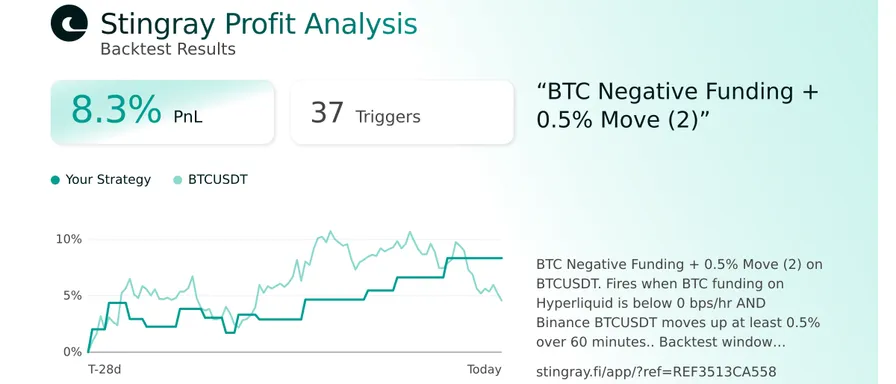
Stingray turns the request into a typed rule before running it. The result includes the trigger list, review windows, data sources, and known limits. The same condition can run as a live monitor after the historical test.
The workflow removes much of the setup work for supported data. A trader can inspect the actual rule as the review artifact.
Code control or faster evidence
Backtrader gives the developer control over every Python function and data object. That is useful for a proprietary calculation, a custom portfolio engine, or a system that must run inside existing infrastructure.
Stingray gets to a reviewable result faster. It suits teams that want to test the thesis before assigning engineering time to a full implementation.
Some teams can use both. Test the idea and its data requirements first. If the rule earns more time and resources, rebuild it in Backtrader when code ownership or custom execution becomes necessary.
Comparing the outputs
A Backtrader result is whatever your code asks the engine to calculate. Built-in analyzers and broker simulation give a strong base, and developers can add their own reports.
A Stingray result follows a consistent review shape: typed condition, trigger history, forward returns, data coverage, and live-monitoring path. That consistency is useful when traders and engineers need to review the same evidence.
Both approaches depend on the quality of the data and assumptions. Commission, slippage, funding, missing bars, and look-ahead errors can change the result. Review those inputs before trusting any performance number.
Live monitoring and orders
Backtrader documents live data and live trading adapters for supported services. Your team runs the process, maintains the connection, and owns the order behavior.
Stingray keeps the tested condition running as a monitor. It sends the signal back to the trader for a decision. Stingray does not place trades.
This boundary is useful when the goal is to check whether historical behavior survives contact with live data before building an execution system.
Which one should you choose?
Choose Backtrader when:
- Your team writes Python.
- You need custom indicators, analyzers, or broker behavior.
- You want to own the data and runtime.
- The strategy will become part of a larger codebase.
Choose Stingray when:
- The thesis begins in plain English.
- You want evidence before assigning engineering time.
- You need the rule and triggers in a consistent review format.
- You want the tested condition monitored live.
- The trader should keep control of the final decision.
Read How to Read a Backtest Card and Backtesting Methodology before comparing results from any platform.
 Web
Web