Turn a Hyperliquid funding-rate thesis into a typed rule, backtest it against venue history, then monitor the same condition with live alerts.
Short answer
To automate a funding-rate strategy on Hyperliquid, do not start by wiring a bot straight to orders.
Start with a precise rule:
Alert me when BTC funding on Hyperliquid is above 0.08% per 8-hour period, price has not broken the prior 4-hour high, and the setup has not fired in the last 4 hours.
Then backtest that exact rule, inspect the historical fires, set a cooldown, and run it as an alert. Stingray is built for that workflow: plain-English thesis, typed rule, Hyperliquid backtest, and live monitoring of the same tested condition. Stingray does not place trades.
What a funding-rate strategy actually does
Funding rates are payments between long and short perpetual futures traders. When funding is deeply positive, longs are paying shorts to keep exposure open. When funding is negative, shorts are paying longs.
That creates two common strategy ideas:
- Mean reversion: crowded funding can mark an overextended side of the market.
- Carry capture: a position can collect funding if price risk is controlled.
- Crowding alert: extreme funding can warn that a move is getting one-sided, even if you do not trade it directly.
The signal is public and repeatable. The hard part is not finding funding data. The hard part is turning the thesis into a rule you can test and monitor without babysitting charts.
The manual execution problem
Manual funding-rate trades break down in predictable ways:
- You check the funding table after the move has already started.
- You miss the signal while sleeping.
- You change the threshold because the chart feels different today.
- You cannot tell whether the setup worked across prior market regimes.
- You execute before separating signal quality from position sizing.
That is why a funding strategy should become a typed rule before it becomes an automated trade. The rule should say what data matters, when it fires, when it stays quiet, and what evidence would make you turn it off.
Describe the strategy in plain English
A usable rule needs an entry condition, an exit or invalidation condition, a cooldown, and a horizon. For example:
Track BTC-PERP on Hyperliquid. If funding is above 0.08% per 8-hour period and BTC has failed to make a new 4-hour high, create a short-bias alert. Do not fire more than once every 4 hours. Show 1-hour, 4-hour, and 24-hour forward returns before live monitoring.
That prompt has enough structure for review:
- Venue: Hyperliquid
- Market: BTC-PERP
- Signal: elevated positive funding
- Price filter: failed breakout
- Cooldown: one fire every 4 hours
- Review windows: 1h, 4h, and 24h
The output should not be a black-box recommendation. It should be an inspectable rule.
Backtest before live monitoring
Funding-rate strategies are easy to overfit. A threshold that looked obvious last week may disappear over a larger window. Before you automate anything, check:
- How many times the rule fired.
- Whether the edge is concentrated in one week or one market event.
- What happened 1h, 4h, and 24h after each fire.
- Whether the same logic still works after fees and slippage.
- Whether a simpler buy-and-hold or do-nothing baseline performed better.
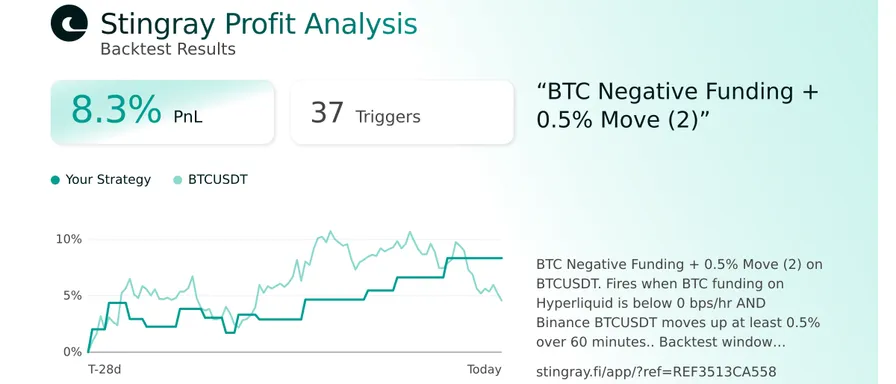
Stingray already supports this style of review. In our funding-rate rule backtest, a negative-funding plus BTC up-move rule produced 37 cooldown-adjusted fires over the test window and beat BTC buy-and-hold by 3.4 percentage points before fees and slippage.
That result does not mean every funding rule works. It shows why the backtest comes first: the trader can see the rule shape before putting capital behind it.
Start with alerts, not blind execution
The safest monitoring path is a simple review loop:
- Define: make the market, threshold, time window, and cooldown explicit.
- Backtest: inspect every historical fire and its forward returns.
- Notify: send Telegram, Slack, WhatsApp, or email alerts when the rule fires.
- Review: compare live behavior with the historical evidence.
- Retire: stop monitoring rules that no longer behave as expected.
This matters because funding can stay extreme for longer than a simple mean-reversion thesis expects. Monitoring should reduce missed signals and manual translation errors. It should not remove trader judgment.
Add more signal layers
Funding alone is rarely enough. Better Hyperliquid strategies often combine funding with other context:
- Price momentum or failed breakout structure.
- Open interest changes.
- Whale wallet positioning.
- Liquidation levels.
- Macro event timing.
- Prediction-market odds.
- News or social catalysts.
The useful workflow is not “run a funding bot.” It is “test whether this funding condition still works after adding the context that should matter.”
For broader platform comparisons, read Best Automated Trading Bots for No-Code Strategy Building and Best 3Commas Alternatives in 2026.
 Web
Web