A disciplined framework for backtesting DOGS or other meme-token momentum without turning social attention into a performance promise.
Short answer
Meme-token momentum can be backtested only when the token identity, venue, liquidity, event timestamps, and trading costs are explicit. A price spike plus social attention is not enough. The rule must show whether the signal arrived before the move, how often it fired, and whether liquidity made the result executable.
This guide uses DOGS, the TON meme token, as an example. Searchers sometimes write “DOG$” or “$DOG,” which can refer to different assets. Resolve the contract, ticker, chain, and venue before testing anything.
Start with asset resolution
DOGS is associated with The Open Network and Telegram’s Spotty character. Market-data sites list it under the ticker DOGS, but similarly named DOG and dog-themed tokens also trade.
Before a replay, lock:
- Contract address and chain
- Venue and trading pair
- Spot or perpetual instrument
- Quote currency
- Listing date and available history
- Minimum liquidity and volume
See the current DOGS market profile on CoinGecko as a discovery reference, then verify the exact instrument on the venue used in the rule.
A testable momentum rule
Instead of “buy when DOGS is trending,” use:
Alert when DOGS/USDT rises at least 8% over four hours, spot volume is at least three times its 30-day median for the same interval, and quoted liquidity remains above a stated threshold. Use a 12-hour cooldown. Show 1-hour, 4-hour, and 24-hour forward returns. Do not activate execution.
The thresholds are examples, not recommendations. Their purpose is to make the thesis inspectable.
Add event time carefully
Meme-token moves often coincide with listings, campaigns, airdrops, social posts, or influencer attention. Historical testing must use the time information became available, not the later publication or indexing time.
Good event filters name the source and timestamp policy. “Social sentiment was high” is too vague unless the dataset, sampling method, and historical coverage are reproducible.
Liquidity is part of the strategy
A backtest based on mid-price candles can look strongest when execution would be worst. For a small or fast-moving token, inspect:
- Spread and available depth
- Volume concentration by venue
- Gaps around listings or maintenance
- Slippage at the intended order size
- Whether the market existed for the full replay window
- Delisting or contract-migration events
If those inputs are unavailable, report a signal replay rather than an achievable-return simulation.
Avoid the common momentum traps
- Ticker collisions: DOGS, DOG, DOGE, and other tokens are not interchangeable.
- Look-ahead bias: later engagement totals cannot trigger an earlier trade.
- Survivorship bias: testing only tokens that remained visible removes failed launches.
- Clustered fires: one viral episode can create dozens of matching rows.
- Cost blindness: spread and slippage can dominate a short-horizon edge.
- Threshold mining: repeatedly optimizing on one launch period creates fragile results.
Where Stingray fits
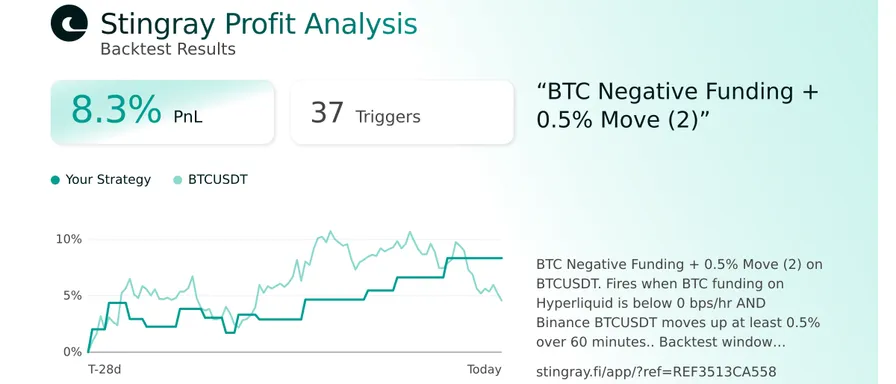
Stingray can resolve the requested market, expose the typed momentum rule, and separate raw samples from cooldown-filtered events. If reliable historical liquidity or social data is missing, the artifact should say so rather than filling the gap with confidence.
The first live step should be an alert. Meme-token momentum is exactly where a notification and manual review are safer than automatic execution.
 Web
Web