A beginner workflow for turning one trading idea into an inspectable rule, reproducible backtest, and alert without writing strategy code.
Short answer
To start with Stingray, describe one trading idea with a market, measurable condition, time window, and a clear instruction not to activate it. Inspect the typed rule, run the historical replay, review every trigger, and only then decide whether to create an alert.
Stingray is not a button that guesses a profitable bot. It is a workflow for turning a thesis into evidence before capital is involved.
Your first prompt
Start with a narrow idea:
Backtest BTC from 2026-04-20 through 2026-05-18. Match when Hyperliquid funding is negative and Binance BTCUSDT rises at least 0.5% over 60 minutes. Use a one-hour cooldown. Show the 1-hour, 4-hour, and 24-hour forward returns. Keep this as a draft and do not activate it.
This works because it states the market, sources, thresholds, replay window, cooldown, output horizons, and activation boundary.
Step 1: inspect the rule
Before reading any chart, confirm that Stingray preserved the instruction:
- BTC is the market.
- Hyperliquid is the funding source.
- Binance BTCUSDT is the price source.
- Funding must be below zero.
- Price must rise at least 0.5% over 60 minutes.
- Only one alert can survive within each one-hour cooldown.
- The rule remains a draft.
Natural language is the input, not the audit trail. The typed rule is what the replay actually evaluates.
Step 2: read the backtest card
Start with coverage and event counts. A condition can stay true over many rows, so raw matches are not independent trades.
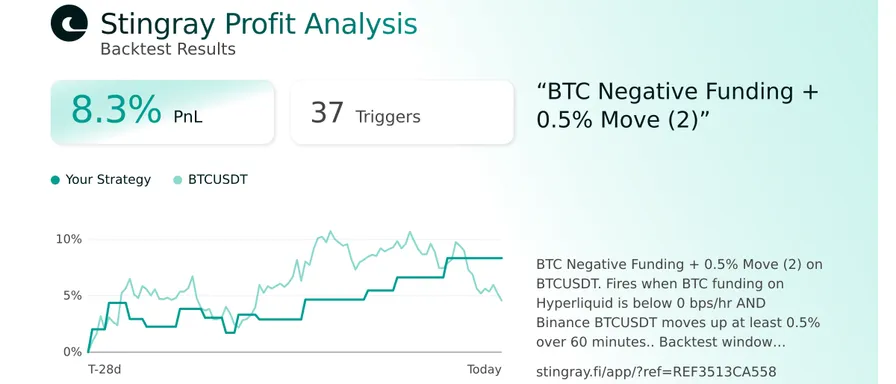
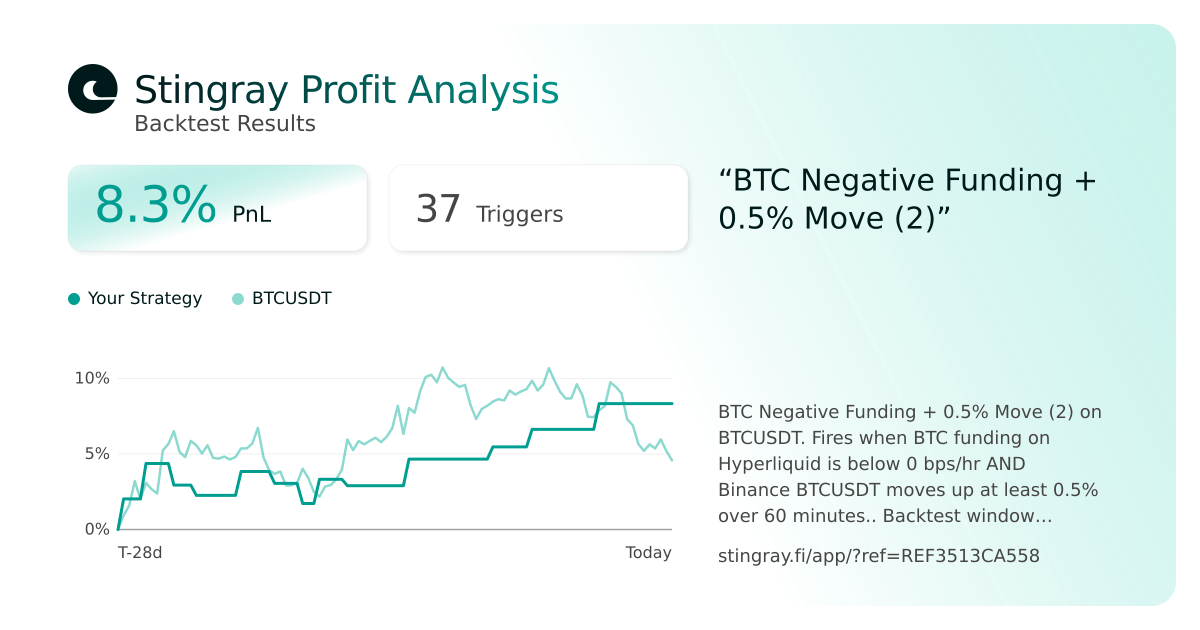
The published version of this example found 150 matching five-minute windows and 37 alerts after cooldown. Its 24-hour forward-return summary was +0.41% on average, +0.55% at the median, and 62% positive. Those figures describe historical price movement after fires; they are not fee-adjusted live P&L.
Use How to Read a Backtest Card for the field definitions and the Backtesting Benchmark Report for the versioned evidence table.
Step 3: decide, do not optimize blindly
A backtest should end in one of three decisions:
- Reject: the rule is unsupported, noisy, rare, or fragile.
- Refine: one explicit assumption needs a new rule and replay.
- Monitor: the result is coherent enough to watch out of sample.
Do not keep changing thresholds on the same period until the chart looks good. That converts the window into training data and weakens the evidence.
Step 4: create an alert first
If the rule deserves monitoring, activate a notification rather than an order. Live alerts reveal whether sources arrive on time, whether fires match the thesis, and whether the market regime has changed.
Stingray stops at the evidence and alert. It does not place trades; the trader decides what to do elsewhere after reviewing the live signal.
What beginners should avoid
- Asking for a “profitable strategy” without a falsifiable condition.
- Treating every raw match as an independent opportunity.
- Ignoring source, interval, coverage, and cooldown.
- Reading a historical average as guaranteed performance.
- Adding leverage before the signal survives live monitoring.
- Allowing execution in the first prompt.
Next step
Repeat the workflow with a thesis you already understand. Keep the first version simple enough that you can explain every condition and every historical fire.
Continue through Stingray Academy or run the complete No-Code Backtesting Tutorial.
 Web
Web