Composer and Stingray both turn plain language into strategies, but they are optimized for different artifacts, data, and markets.
Short answer
Composer is a strong choice for building, backtesting, and automating systematic stock and ETF portfolios. Stingray is the stronger fit when the thesis depends on venue-specific market data such as perpetual funding, open interest, onchain activity, prediction markets, or event context.
Both products make strategy creation more accessible. They solve different market and evidence problems.
Comparison at a glance
| Question | Composer | Stingray |
|---|---|---|
| Main strategy shape | Portfolio allocation and rebalancing “Symphonies” | Typed multi-source market conditions |
| Typical markets | Stocks and ETFs | Onchain rails, beginning with crypto and perpetual venues |
| Natural-language workflow | AI-assisted strategy editor | Thesis to typed rule, replay, alert, and live monitoring |
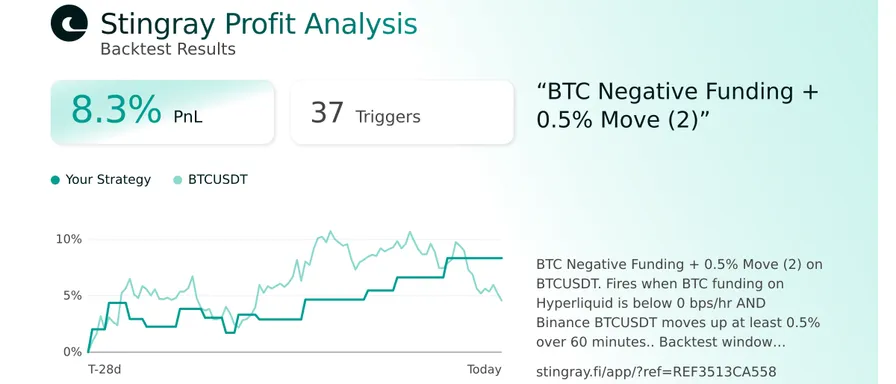
| Backtest output | Portfolio performance against a benchmark | Trigger history, cooldown sets, forward returns, coverage, and limitations |
| Live workflow | Deploy a Symphony or trade through supported brokerage paths | Monitor the same tested condition; Stingray does not place trades |
What Composer is built for
Composer’s official site describes AI-assisted algorithm creation, historical backtesting, and automated execution in one platform. A strategy is represented as a “Symphony” made from filters, conditions, assets, and weighting logic. Its API exposes Symphonies, backtests, deployment, portfolio management, and direct trading.
That model fits questions such as:
- Allocate across a set of ETFs based on trend or volatility.
- Rotate between assets when a portfolio condition changes.
- Compare a systematic portfolio with a benchmark.
- Automate recurring rebalances.
See Composer’s official product site and API documentation.
What Stingray is built for
Stingray fits a different thesis:
Backtest BTC long signals when Hyperliquid funding is negative, Binance spot momentum is positive, and open interest is expanding.
This rule depends on venue-specific derivatives and cross-source data. The relevant artifact is not primarily a portfolio equity curve. It is a typed condition, a list of historical fires, cooldown behavior, forward returns, and source limitations.
Crypto is the first unusually observable market for this workflow, not the intended boundary. The same evidence pattern applies as traditional instruments and settlement move onto programmable rails.
The important backtest difference
Composer’s own backtesting guide notes that historical simulation uses assumptions and can differ from live trading. Stingray makes the same distinction through source coverage, replay semantics, and the separation between signal outcomes and full P&L.
Neither platform can turn a historical result into a guarantee. The useful question is whether the backtest represents the strategy you intend to run and exposes the assumptions that could break it.
Read Composer’s Backtesting Basics and Stingray’s Backtesting Methodology.
Choose Composer when
- The strategy is primarily a stock or ETF portfolio.
- Allocation, weighting, and rebalance logic are central.
- You want an integrated brokerage and automation path.
- Composer’s Symphony primitives express the rule clearly.
Choose Stingray when
- The thesis combines funding, open interest, venue price, news, macro, prediction markets, or onchain signals.
- You need every trigger rather than only a portfolio summary.
- You want a typed alert rule and live monitoring for a multi-source thesis.
- Source identity, timestamp semantics, and cooldown behavior are part of the evidence.
Verdict
Composer is not a generic competitor to every Stingray workflow, and Stingray is not a replacement for Composer’s systematic portfolio product.
Use Composer for no-code portfolio algorithms across its supported assets. Use Stingray for multi-source market theses that need venue-aware replay, trigger evidence, and alert-first live monitoring.
 Web
Web