A practical workflow for turning a plain-English market idea into a typed rule, backtest, alert, and controlled automation path without writing code.
Short answer
To automate an onchain trading strategy without writing code, do not start with a bot switch. Start with a rule.
Write the trading idea in plain English, convert it into an inspectable condition, backtest that exact condition, review the historical fires, and monitor the same condition live. Then decide whether it deserves more time and resources.
That sequence matters because “no-code” should remove programming work, not remove strategy review.
The workflow
| Step | What you do | What good looks like |
|---|---|---|
| 1. Write the thesis | Describe the market setup in plain English | The idea names the asset, venue, signal, time window, and desired action |
| 2. Make it precise | Turn the thesis into a typed rule | The rule exposes thresholds, data sources, cooldowns, and invalidation logic |
| 3. Backtest it | Test the exact rule against historical data | You can see every trigger and what happened afterward |
| 4. Review the evidence | Check fires, forward returns, fees, slippage, and baselines | The rule still makes sense after details are visible |
| 5. Start with alerts | Send notifications to Telegram, WhatsApp, Slack, or web | You can compare live behavior with the backtest |
| 6. Add controls | Define cooldowns, risk limits, and stop conditions | Automation cannot drift outside explicit boundaries |
| 7. Decide what is next | Review live behavior before committing more resources | The strategy follows evidence, not impulse |
Example prompt
A weak no-code prompt looks like this:
Buy ETH when it looks strong.
That is too vague. A better prompt is:
Track ETH on Hyperliquid and Binance. Alert me when ETH reclaims the prior 4-hour high, Binance spot volume is at least 1.5x the 24-hour average, and Hyperliquid funding is not extremely positive. Do not fire more than once every 4 hours. Show 1-hour, 4-hour, and 24-hour forward returns before activation.
This prompt gives the system enough structure to produce a rule:
- Asset: ETH.
- Venues: Hyperliquid and Binance.
- Price condition: reclaim of prior 4-hour high.
- Volume filter: 1.5x the 24-hour average.
- Funding filter: avoid overcrowded positive funding.
- Cooldown: one fire every 4 hours.
- Review windows: 1h, 4h, and 24h.
The output should be a rule you can inspect, not just a confident answer.
Why the typed rule matters
Plain English is useful because it lets traders start from the thesis. But the final strategy cannot stay as prose.
Before anything goes live, the idea must become a typed rule: exact market, exact threshold, exact time window, exact data source, exact cooldown, and exact activation boundary.
That is where many no-code workflows fail. They make setup easy, but they hide the thing that matters most: what actually triggers.
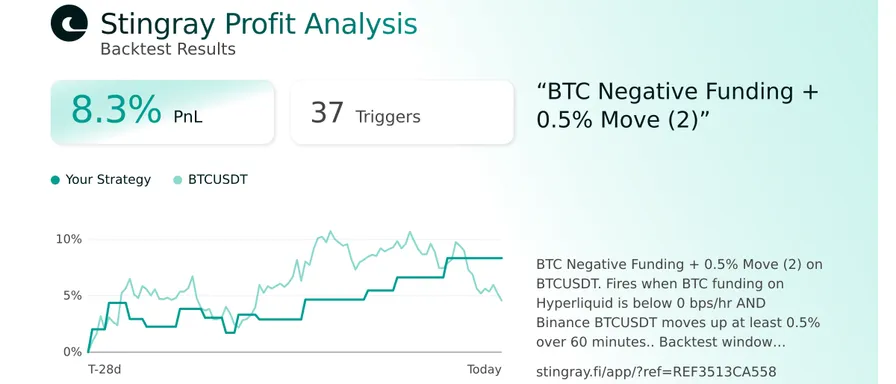
Stingray is built around this gap. It turns the plain-English idea into a structured strategy workflow so the trader can inspect the rule, run the backtest, and monitor the exact condition.
Backtest before automation
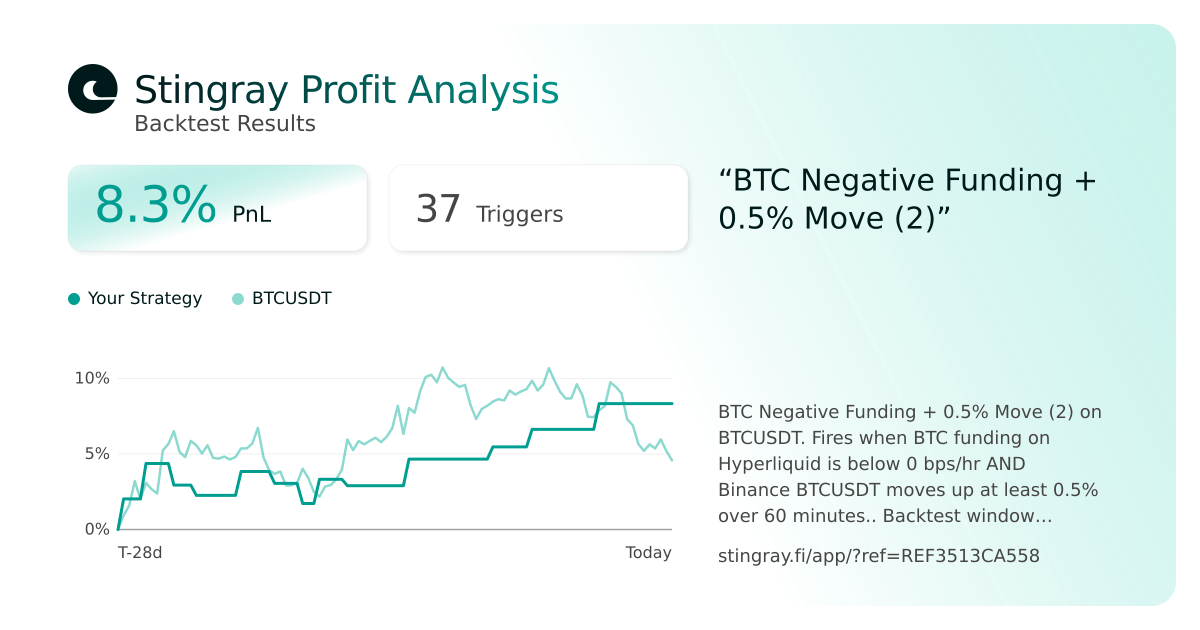
A backtest is not a guarantee, but it is the minimum evidence check before automation.
Look for:
- How many times the rule fired.
- Whether results are concentrated in one market event.
- What happened 1h, 4h, and 24h after each fire.
- Whether cooldowns prevent repeated duplicate signals.
- Whether fees and slippage would erase the result.
- Whether a simple baseline performed better.
- Whether the rule is stable enough to monitor live.
If a tool cannot show those details, it may be automating a story instead of a strategy.
Start with alerts
For most traders, the first useful automation is not order execution. It is reliable monitoring.
Start by sending alerts when the tested rule fires. Use the channels you already watch, such as Telegram, WhatsApp, Slack, or the web. Then compare live triggers with the backtest:
- Did the signal fire at sensible times?
- Did it miss obvious setups?
- Did it fire too often?
- Did the market context match the historical pattern?
- Did you still want to act when the alert arrived?
This stage is where bad rules usually reveal themselves without putting capital at risk.
Add monitoring controls
If the alert version behaves well, define controls before committing more time and resources:
- Market and data-source scope.
- Cooldown between fires.
- Time-of-day or event restrictions.
- Stop or invalidation condition.
- Manual review for higher-risk setups.
- Review schedule for turning the rule off.
No-code automation should make those boundaries clearer, not easier to skip.
When to use Stingray versus a bot platform
Use Stingray when the strategy still needs to be proven. It is strongest when you want to move from a thesis to a typed rule, backtest, alert, and live-condition monitoring.
Use a bot platform when the strategy is already defined and the main job is execution mechanics: grid bot, DCA bot, signal bot, copy bot, or exchange-connected order routing.
Many traders need both categories at different times. The important order is: prove the rule first, then decide how to execute it.
Verdict
You can automate an onchain trading strategy without code, but the safe workflow is not “describe idea, place trade.” It is:
- Describe the thesis.
- Convert it into a typed rule.
- Backtest the rule.
- Review every trigger.
- Run alerts.
- Add controls.
- Decide whether the strategy deserves more time and resources.
That is the difference between no-code automation and blind automation.
Next reads:
 Web
Web