Learn what Stingray is, how it turns plain-English market theses into typed rules on onchain rails, and how traders can backtest, monitor, and deploy strategies without writing code.
Short answer
Stingray is a trading strategy backtesting and monitoring platform built for onchain rails. It turns plain-English trading ideas into structured strategies that can be backtested, monitored, and deployed without writing code.
Crypto markets are the first perfect-information surface Stingray covers: venue data, funding, prediction markets, and on-chain activity are observable enough to test ideas rigorously. The product frame is broader than crypto speculation. It is built for market workflows as traditional finance moves onchain.
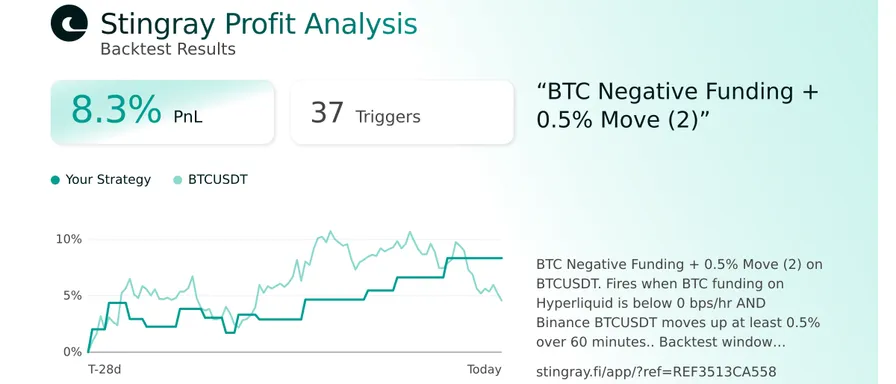
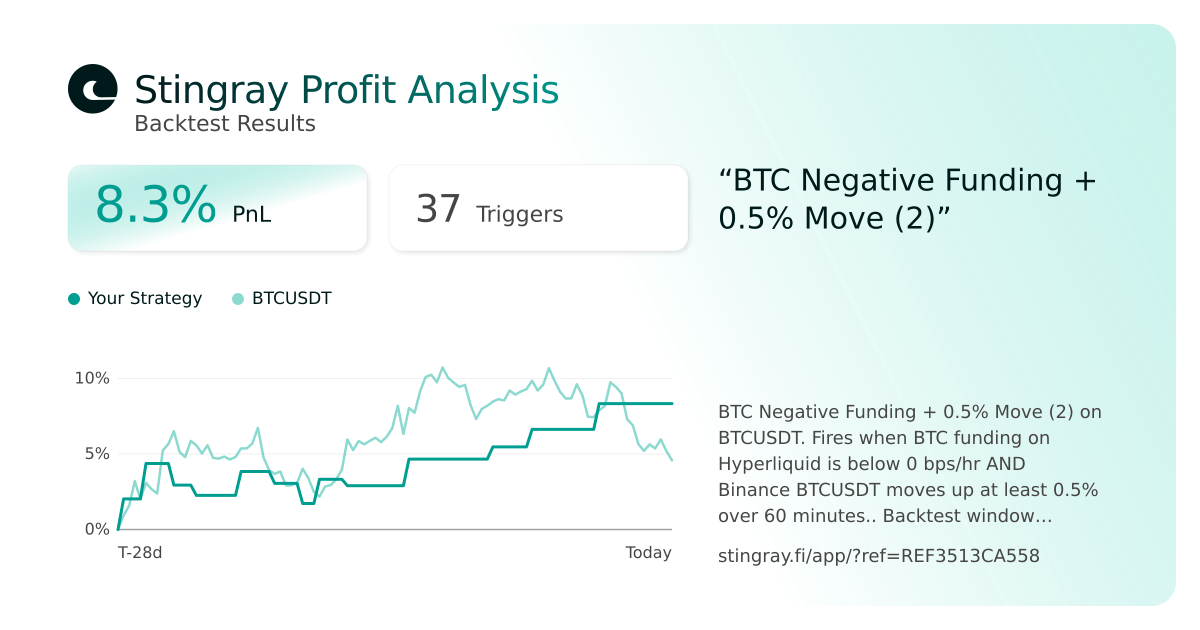
Instead of starting with a bot template, Stingray starts with the trading thesis. A trader describes a setup involving price, funding rates, venue behavior, macro events, news, or prediction-market odds. Stingray converts that idea into a typed rule, tests it against historical data, then starts alerts and monitors the same conditions live.
The Stingray workflow
| Step | What happens | Why it matters |
|---|---|---|
| 1. Describe the idea | Write the strategy in plain English | Traders can start from the thesis, not from code or bot parameters |
| 2. Compile the rule | Stingray converts the idea into a structured condition | The strategy becomes inspectable instead of staying vague |
| 3. Source the data | The rule can reference market, venue, funding, news, macro, and prediction-market inputs | Onchain trading strategies often need more than price alone |
| 4. Backtest | Stingray checks when the rule would have fired historically | The trader sees evidence before any live risk |
| 5. Review triggers | Inspect each signal, forward return, cooldown, and assumption | This catches rules that look good only in summary |
| 6. Monitor | Start with alerts through channels such as Telegram, WhatsApp, or Slack | Live behavior can be compared with the backtest |
| 7. Decide what is next | Review live behavior before committing more resources | Evidence guides the next decision |
Example
A trader might write:
Alert me when ETH funding on Hyperliquid turns negative, BTC momentum is recovering, and Binance spot volume is rising faster than the prior day.
Stingray turns that sentence into a precise condition. The trader can see the rule, run the backtest, inspect each historical fire, and decide whether the setup deserves continued monitoring and more resources.
What Stingray is not
Stingray is not just a chatbot that gives trading opinions. A useful answer must become a testable rule.
Stingray is also not only a bot marketplace. Bot platforms are useful once the execution pattern is already known. Stingray sits earlier in the workflow: it helps prove whether the strategy is worth running.
The product is best understood as the research, backtesting, and live-condition monitoring layer for trading strategies on onchain rails.
What Stingray automates
Stingray can reduce the manual work around:
- Translating a trading idea into a structured rule.
- Checking whether the rule would have fired on historical data.
- Combining data sources such as price, funding, macro, news, and venue behavior.
- Creating alerts that track the exact tested condition.
- Reviewing live signals before deciding whether an idea deserves more resources.
- Keeping a strategy runtime available without the trader writing infrastructure code.
That does not remove trading judgment. It makes the judgment more concrete by forcing every idea into a rule that can be inspected.
Why the typed rule matters
Plain English is easy to write, but it can be ambiguous. “Momentum is improving” might mean one thing to a discretionary trader and something else to a backtest engine.
Stingray’s job is to turn that language into a typed condition: the assets, venues, thresholds, time windows, cooldowns, and data sources. Once the strategy is typed, the trader can ask better questions:
- Did this exact rule fire before?
- How often did it fire?
- What happened after each fire?
- Which assumptions changed the result?
- Is the rule stable enough to monitor live?
That is the difference between an AI suggestion and an automated strategy workflow.
When to use Stingray
Use Stingray when:
- You have a market thesis but not a coded strategy.
- You want no-code backtesting before execution.
- Your idea depends on Hyperliquid, Binance, funding, macro, news, or cross-venue context.
- You want alerts before live orders.
- You need to review historical and live triggers before scaling.
If you already know the exact execution bot you want, a bot platform may be enough. If you are still proving the idea, Stingray belongs first.
Verdict
Stingray turns market theses into testable strategy workflows by making them precise: plain English becomes a typed rule, the rule is backtested, the evidence is reviewed, and the same tested condition is monitored live.
The crypto examples matter because they are the current perfect-information starting point, not because Stingray stops at crypto.
That is the core difference: Stingray helps traders prove which ideas deserve more time and resources.
Next reads:
 Web
Web