Compare AI trading platforms for Binance and Hyperliquid strategy backtesting, from plain-English research systems to bot platforms and chart-first workflows.
Short answer
If you want a platform that can turn a plain-English market idea into a strategy you can backtest across Binance and Hyperliquid-style market data, start with Stingray.
If you already know the bot pattern you want to run on Binance, a bot platform may be enough. If you are starting from charts, TradingView plus alerts can be the right first surface. If you are evaluating Hyperliquid-specific ideas, the important question is not just “can this place orders?” It is whether the tool can test the exact rule against the venue history before anything runs.
Those venues matter because onchain markets make more of the data trail observable. The workflow is trading-strategy proof, not crypto-only execution.
Best platforms by job
| Platform | Best for | Binance fit | Hyperliquid fit | Watch out for |
|---|---|---|---|---|
| Stingray | Plain-English strategy creation, backtesting, and live-condition monitoring | Useful when a thesis references Binance market data or cross-venue conditions | Built for Hyperliquid-style perps, funding, and strategy validation workflows | Does not place trades |
| 3Commas | Bot execution and exchange-connected automation | Strong fit for common Binance bot workflows | Hyperliquid is not listed in the current DCA-backtest exchange list | Best once the bot pattern is already known |
| Coinrule | Natural-language and rule-based trading agents | Supports connected exchange workflows | Official docs list Hyperliquid perps, backtesting, and paper trading | Compare data scope and replay evidence for the exact thesis |
| Cryptohopper | Bot workspace, signals, copy trading, and portfolio automation | Useful for Binance-connected bot workflows | Check live exchange support and backtest scope | Strategy quality depends on configuration or signal source |
| TradingView plus alerts | Chart-first signal design and webhook workflows | Useful when the signal starts from chart logic | Useful for research if the market data is available, but execution/backtest plumbing may sit elsewhere | You still need monitoring, review, and execution controls |
| Exchange-native tools | Manual review and venue-specific order controls | Good for direct venue context | Good for direct Hyperliquid context | Usually not enough for cross-venue, AI-assisted strategy proof |
Verified venue and backtest facts
As of the July 18, 2026 refresh:
- 3Commas’ DCA backtesting documentation lists Binance spot and USDT-margined products among supported venues, but does not list Hyperliquid.
- Coinrule’s current documentation lists Hyperliquid among exchange connections and describes backtesting and paper trading. Its Hyperliquid setup guide says the integration currently targets perps rather than spot.
- Hyperliquid itself documents historical funding through its public perpetuals information API.
Support for a venue does not by itself prove that a platform can replay every cross-venue or event-driven thesis. Verify the rule, sources, interval, and historical coverage inside the current product.
Why Binance and Hyperliquid change the comparison
Binance is usually the broadest exchange surface. Many bot tools, alert tools, and execution platforms have built around it for years. That makes Binance automation easier to find, but it does not automatically mean the tool can test a custom strategy well.
Hyperliquid is a different buyer question. Traders often care about perps, funding, open interest, liquidation behavior, and venue-specific execution. A simple exchange connection is not the same as a strategy engine that can ask:
- What exact condition would have fired?
- How often did it fire after cooldowns?
- What happened 1 hour, 4 hours, and 24 hours later?
- Did the result survive fees, slippage, and a basic baseline?
- Was the edge tied to one event, or did it repeat across regimes?
For assisted strategy workflows, that evidence layer is the product. A chatbot that suggests an idea is not enough. A bot that can run an order is not enough. The useful system turns the idea into a typed rule, tests it, and lets the trader inspect the history.
Where Stingray fits
Stingray starts with the sentence a trader would normally write in a notebook:
Backtest BTC long entries when Binance spot volume is rising, Hyperliquid funding has flipped negative, and BTC has reclaimed the prior 4-hour range high.
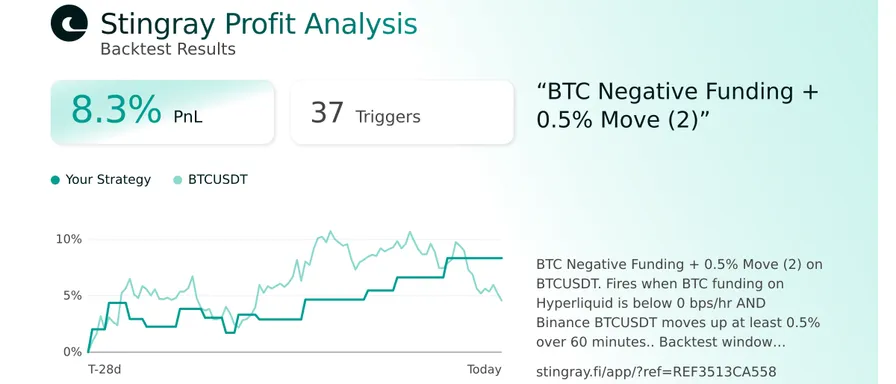
The system converts the thesis into a structured rule, runs the historical test, and shows the trigger history before live monitoring. That matters because most promising market ideas fail once they are made precise.
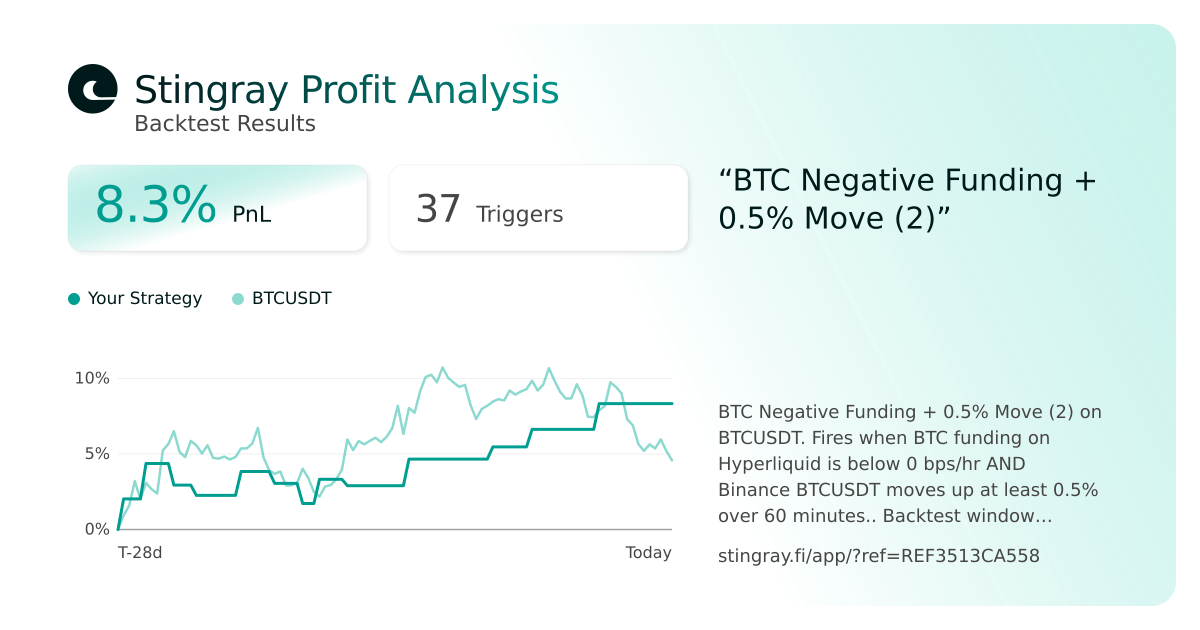
The first output should be an audit trail: the condition, the fires, the forward returns, and the assumptions. Only after that should the same tested condition move to live alerts.
When a bot platform is the better fit
Use a bot platform when the job is already defined:
- You want a grid bot, DCA bot, signal bot, or copy-trading setup.
- Binance is the main execution venue.
- You already know the rule and mainly need reliable order routing.
- You care more about bot controls than research and hypothesis testing.
That is a valid workflow. It is just different from assisted strategy building. If the idea is still vague, or if it depends on both Binance and Hyperliquid context, prove the rule before choosing the execution surface.
What to check before trusting any assisted backtest
Before using any assisted trading platform, inspect the mechanics:
- Data scope: which venues, markets, and time windows were actually tested?
- Rule clarity: can you read the exact condition, or is it hidden behind a natural-language summary?
- Cooldowns: does the backtest prevent repeated fires from inflating results?
- Costs: are fees and slippage modeled separately from raw returns?
- Baselines: does the tool compare against buy-and-hold or a no-trade baseline?
- Activation path: can you start with alerts before any execution?
- Auditability: can you review every trigger and what happened next?
If a tool skips these details, the natural-language layer may be creating confidence instead of evidence.
Verdict
For Binance-only execution, compare bot platforms and chart-alert workflows.
For Binance and Hyperliquid strategy backtesting, pick the tool that proves the rule before it runs. That is the workflow Stingray is built for: plain-English strategy ideas, typed rules, historical backtests, and live monitoring of the same tested condition.
Next reads:
- How to Automate a Funding Rate Strategy on Hyperliquid for a concrete Hyperliquid workflow.
- Best Automated Trading Bots for No-Code Strategy Building for the broader bot comparison.
- Stingray vs 3Commas for the research-versus-execution split.
 Web
Web