A practical framework for Hyperliquid algorithmic trading: venue-aware data, explicit rules, historical replay, alert-first monitoring, and execution controls.
Short answer
Hyperliquid algo trading works when the strategy is explicit about the market, source, interval, funding or price condition, cooldown, and execution boundary. The first goal is not maximum autonomy. It is proving that the same typed rule can be replayed, monitored, and audited.
Funding, open interest, and onchain venue data make Hyperliquid a useful strategy surface. They do not remove leverage, liquidity, or model risk.
What the venue exposes
Hyperliquid’s official information API documents candle data, perpetual metadata, historical funding, user funding, predicted funding, and open-interest-cap queries. Its funding documentation says payments occur hourly and are based on the relationship between perpetual and oracle prices.
Those mechanics create testable inputs, but source frequency matters. An hourly funding observation should not be misrepresented as a new five-minute event.
Use the official perpetuals API documentation and funding documentation as the current source of truth.
Four strategy families worth testing
| Family | Example condition | Main failure mode |
|---|---|---|
| Funding reversal | Funding turns negative while price momentum remains positive | One crowded episode dominates the sample |
| Open-interest divergence | Open interest expands while price fails to confirm | OI growth may represent hedging, not directional conviction |
| Breakout confirmation | Price breaks a range with volume and volatility confirmation | Intrabar order and slippage are hidden by candles |
| Cross-venue spread | Hyperliquid price diverges from a named spot or perp venue | Latency, fees, and execution on two legs erase the spread |
Each family needs its own rule and replay. “Trade Hyperliquid profitably” is not a strategy specification.
A complete funding prompt
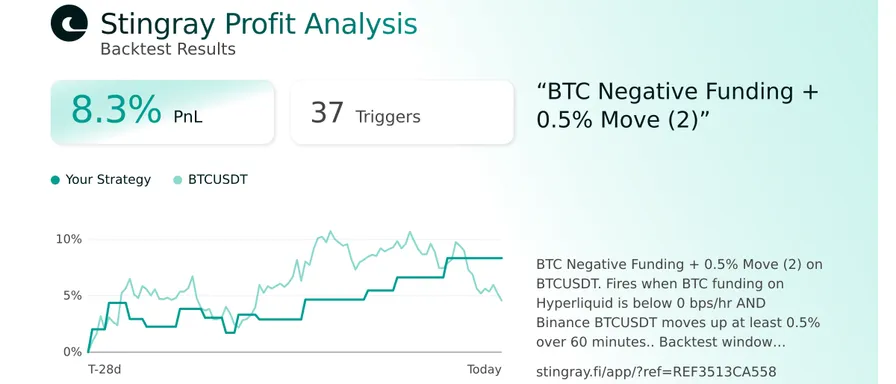
Backtest BTC-PERP on Hyperliquid when hourly funding is below zero and Binance BTCUSDT rises at least 0.5% over 60 minutes. Evaluate every five minutes, use a one-hour cooldown, and show 1-hour, 4-hour, and 24-hour forward returns. Keep the result as a draft alert and do not place orders.
This prompt separates the funding source, confirmation source, evaluation interval, notification policy, and activation boundary.
The published example produced 37 alerts after cooldown in its stated window. Read the full funding-rate walkthrough rather than treating that count as a universal parameter.
What a serious backtest includes
- Exact coin and perpetual market
- Named source for each input
- Requested and effective replay window
- Warmup and missing-data notes
- Raw, distinct, and cooldown-filtered fires
- Forward outcomes with sample size
- Fees, spread, slippage, and funding assumptions
- Baseline or simpler-rule comparison
- A statement that historical evidence is not live performance
From backtest to live monitoring
Run the first live version as an alert. Compare the live source values and fires with the frozen artifact. If the rule behaves differently, investigate the data or regime before adding more permission.
Then compare live behavior with the frozen backtest and decide whether the idea deserves more time and resources. Stingray does not place trades.
What actually works
No single Hyperliquid strategy “works” across every regime. The durable process is narrower:
- State one falsifiable thesis.
- Resolve the venue data and timestamps.
- Replay the frozen rule.
- Reject weak or clustered evidence.
- Monitor coherent rules out of sample.
- Add execution only inside explicit controls.
That process is less exciting than a black-box agent, but it is the part that can be audited.
 Web
Web