A practical explanation of Stingray pricing, current plan limits, and which plan fits the volume and complexity of your strategy workflows.
Short answer
Stingray is worth considering if you regularly turn market research into monitored strategies and want backtesting, alerts, watchlists, portfolio context, and typed strategy workflows in one place.
Today, many examples start with crypto because onchain markets expose the data needed for rigorous testing. That should not be confused with the boundary of the product: the value is strategy proof for markets moving onchain.
It is less compelling if you only need charts, a simple execution bot, or occasional market summaries. Stingray is priced around usage: the more research, backtests, alerts, and agent workflows you run, the more headroom you need.
Always check the live pricing page before buying. Plan limits and prices can change, and the pricing page is the source of truth.
Current pricing at a glance
The currently published pricing page lists three paid plans. Every new account starts with included usage automatically; it is not a selectable plan.
| Plan | Price/mo | Usage/mo |
|---|---|---|
| Starter | $20 | 5M |
| Pro | $50 | 50M |
| Scale | $200 | 300M |
There is also an enterprise path for custom limits or onboarding.
What is included
The pricing page currently lists these capabilities across the public plans:
- Backtests.
- Alerts, watchlists, and portfolio workflows.
- Web, Telegram, WhatsApp, Telegram groups, and agent channels.
- Memory, personalization, Tokenpedia, knowledge graph, news correlation, event correlation, and price correlation.
- Token prices from Binance, perps from Hyperliquid, prediction markets from Polymarket, and tracked news sources.
The important point is that Stingray is not priced only as a chat surface. The paid value comes from the workflow around the chat: turning ideas into rules, testing those rules, monitoring them, and keeping enough usage available for repeated research.
What is marked soon
The pricing comparison currently marks some areas as “Soon”, including action paths, recommendations, wallet tracking, equities, and macro data.
That matters for deciding whether to pay today. If your whole use case depends on one of those future primitives, use the included account usage first and wait for the exact capability you need to appear on the live pricing page.
If your workflow already depends on backtests, alerts, watchlists, Hyperliquid perps, Binance prices, prediction markets, or news correlation, the current plans are much easier to evaluate.
When Stingray is worth it
Stingray is most likely worth it when you have one of these workflows:
- You write trading ideas in plain English but need them converted into precise, testable rules.
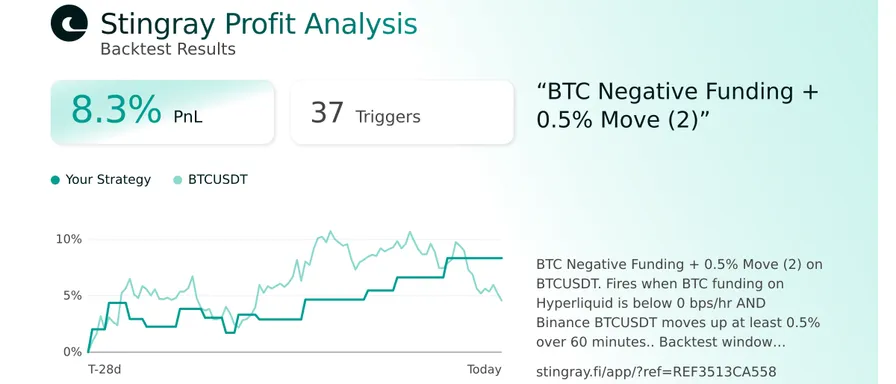
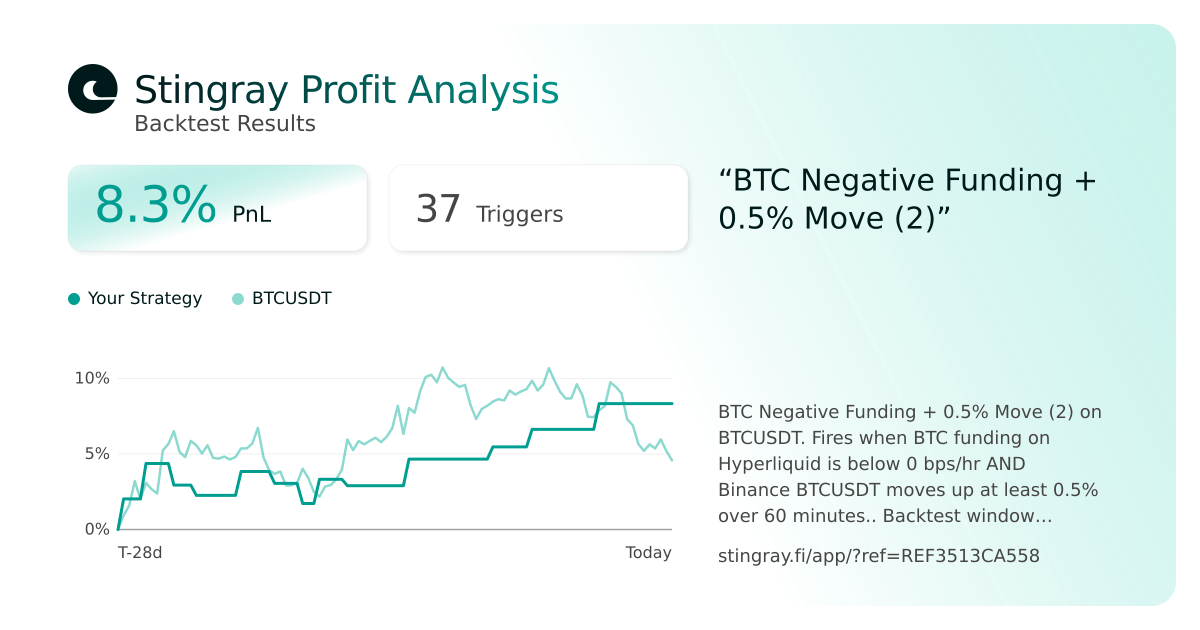
- You want to backtest a rule before deciding whether it deserves a live alert.
- You monitor multiple assets, venues, and narratives and need fewer disconnected tabs.
- You care about Hyperliquid, Binance, funding rates, news, and prediction-market context.
- You want alerts delivered to channels you already use.
- You are moving from discretionary research toward systematic workflows, but you do not want to build infrastructure.
In those cases, the paid plans are buying time and decision quality: fewer manual checks, faster validation, and more room to test ideas repeatedly.
When Stingray may not be worth it
Stingray may not be worth paying for if:
- You only need charting and manual trading.
- You already have a working execution bot and do not need research or backtesting.
- You trade so rarely that the usage included with your account is enough.
- You need features that are still marked “Soon” before the platform becomes useful to you.
- You prefer building every rule and data pipeline yourself.
That does not make Stingray a bad tool. It means the value depends on whether you actually use the strategy workflow, not just the interface.
Which plan should you start with?
Use the included account usage to understand the product and run a small number of workflows. It is added automatically, not chosen from the pricing page.
Starter is the natural first paid plan for a trader who wants daily monitoring and live workflows. Pro is better when you run denser research, more backtests, or always-on monitoring. Scale is for heavier usage where limits become the constraint.
| Your current bottleneck | Plan to evaluate first |
|---|---|
| Learning the workflow and testing a few theses | Included account usage |
| Daily alerts and a small set of live strategy rules | Starter |
| Repeated backtests, broader research, and always-on monitoring | Pro |
| Sustained high-volume research and monitoring where usage is already the constraint | Scale |
Do not upgrade only because a plan exists. Upgrade when usage limits or workflow volume become the bottleneck.
Verdict
Stingray is worth it if your edge depends on turning research into tested, monitored strategy workflows. The strongest fit is a trader who wants to move from “I have an idea” to “this exact rule has evidence and can be watched live” without writing code.
It is not worth it as a generic charting subscription or as a replacement for trading judgment. The value is in the loop: idea, typed rule, backtest, alert, review, and careful activation.
Next reads:
 Web
Web