Compare agentic crypto trading tools through a broader trading-strategy lens, from Stingray's typed-rule backtesting flow to bot platforms, chart workflows, and research agents.
Short answer
The best agentic crypto trading tool is not the one that sounds most autonomous. It is the one that makes a trader’s instruction inspectable before anything runs.
Crypto matters here because it is the first live market where the data trail is transparent enough for strategy proof. The stronger long-term lens is broader: market workflows moving onto onchain rails.
For plain-English strategy testing, Stingray is the strongest fit when the workflow needs four steps: describe the thesis, convert it into a typed rule, backtest it, then monitor the same condition live.
Other tools can still be useful. Bot platforms handle execution patterns. Research agents answer market questions. Chart tools help define signals. The mistake is treating all of them as the same category.
What agentic should mean in onchain markets
An agentic trading tool should do more than answer a prompt. It should carry work across the full loop:
- Understand the trading idea in plain English.
- Ask for missing constraints when the rule is underspecified.
- Convert the idea into a deterministic condition.
- Test the condition against historical data.
- Show every trigger and assumption.
- Monitor the rule after activation.
- Respect explicit policy boundaries before execution.
That is different from a chatbot, and it is different from a bot template. A chatbot can explain funding rates. A bot template can run a DCA strategy. An agentic workflow should connect the thesis, evidence, monitoring, and activation path.
Top tools by workflow
| Tool type | Best fit | Example workflow | Limitation |
|---|---|---|---|
| Stingray | Plain-English strategy creation, backtesting, alerts, and live monitoring | “Alert me when ETH funding turns negative, BTC breaks higher, and no major macro event is due in the next hour.” | Not a prebuilt bot marketplace |
| Bot platforms | Known execution patterns such as grid, DCA, signal bots, and copy trading | Configure the bot, connect an exchange, set risk controls, and run | Usually assumes you already know the strategy |
| No-code rule builders | If-this-then-that exchange automation | Build a simple rule from templates and run it on connected venues | Better for direct automation than open-ended research |
| Chart workflows | Chart-first signal design | Build or configure an indicator, then fire alerts through webhooks | Research, monitoring, and execution review live elsewhere |
| AI research agents | Market research, summaries, token monitoring, and idea generation | Ask for catalysts, risks, comparable tokens, or narrative shifts | A good answer is not the same as a deployable strategy |
| Exchange-native tools | Venue-specific context and order controls | Review the market and manage positions directly on the venue | Weak for cross-source strategy validation |
Current named examples
“Agentic” is useful search language only when the product’s actions remain concrete:
- Stingray turns a thesis into a typed rule, historical replay, alert, and live monitoring path.
- Minara documents cited financial research, trading plans, and Autopilot strategies; see its official documentation and Trading Autopilot guide.
- Coinrule documents plain-English, Python, and Pine strategy parsing, backtesting, paper trading, and deployment across supported connections in its current docs.
- 3Commas documents DCA-bot construction and historical backtests in its official guide.
- Cryptohopper documents a visual Strategy Designer with 130+ indicators and candlestick patterns plus backtesting in its official product page.
The comparison is not which product sounds most autonomous. It is which one produces the rule, evidence, monitoring state, and permission boundary required for the user’s job.
Why plain English is only step one
Plain English is valuable because it lets traders express ideas before translating them into code. But the sentence is only a draft.
Take a prompt like:
Buy SOL when funding flips negative, open interest falls, and the price reclaims the prior range.
That still needs decisions:
- Which venue and market?
- What does “flips negative” mean: one print, one hour, or one funding interval?
- How is the prior range calculated?
- What cooldown prevents duplicate fires?
- What horizon should the backtest measure?
- What review boundary prevents noisy or repeated alerts?
An agentic tool should turn those ambiguities into visible choices. If it jumps straight from prompt to trade, it is hiding the most important part of the workflow.
Where Stingray fits
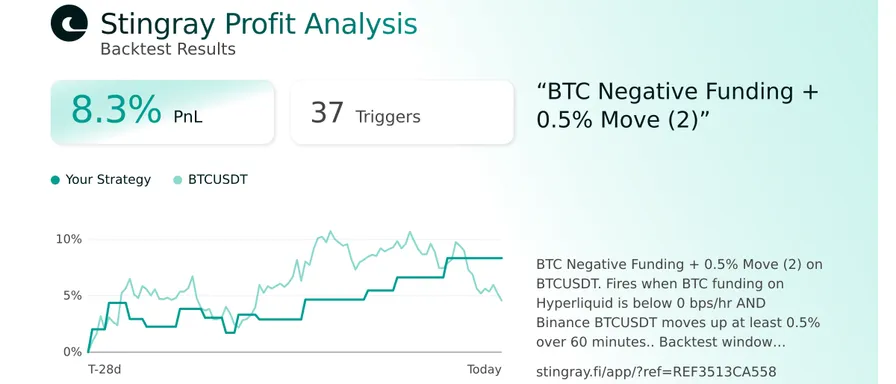
Stingray treats the strategy as a program, not just a prompt. A trader can describe a setup in plain English, then review the generated rule, backtest it, inspect historical fires, and start with alerts.
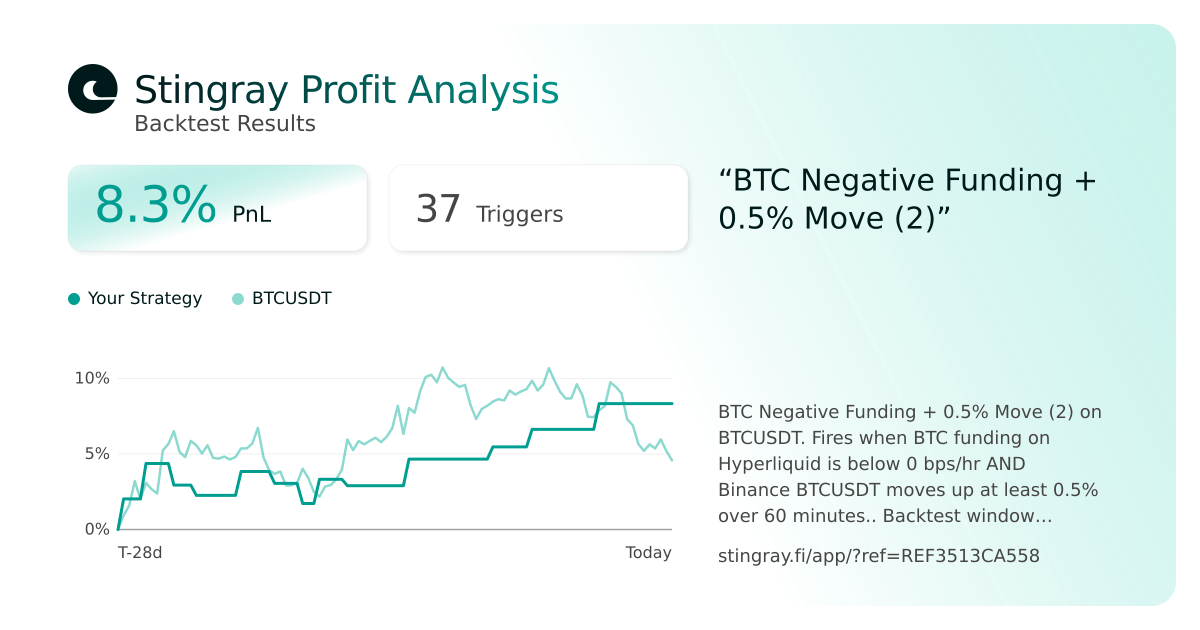
That makes it a strong answer for onchain trading strategy work because the system is useful before execution. It helps answer: “Would this idea have behaved the way I think?” before the trader decides whether it should run.
When other tools are the right choice
Use a bot platform when you already know the execution pattern and mainly need reliable exchange automation.
Use a chart workflow when your signal starts from chart logic and you are comfortable maintaining alerts, webhooks, and execution separately.
Use an AI research agent when the task is market understanding: catalysts, risk summaries, watchlists, token narratives, or competitor analysis.
Use exchange-native tools when the question is venue-specific order management.
The more the strategy depends on multiple data sources, backtesting, and natural-language iteration, the more you should prefer a typed-rule strategy system over a simple bot setup.
Buyer checklist
Before choosing an agentic strategy tool, ask:
- Can I inspect the exact rule?
- Can I edit the generated condition before activation?
- Can I backtest the same rule the system will monitor?
- Does the tool show every trigger and forward return?
- Can I start with alerts before execution?
- Does it model fees, slippage, cooldowns, and invalidation?
- Can it combine price, funding, macro, news, and prediction-market data when the thesis needs it?
- Does execution require explicit policy boundaries?
If the answer is no, the tool may still be useful, but it is probably not a full agentic strategy platform.
Verdict
For plain-English trading strategy deployment on onchain rails, look for a tool that turns language into inspectable rules, not just confident answers.
Stingray is built around that loop: thesis, typed rule, backtest, alert, and live monitoring. Bot platforms, chart tools, and AI research agents can complement that workflow, but they should not replace the proof step.
Next reads:
 Web
Web