Trading Strategy Backtesting Platform Comparison: What to Check Before You Go Live
Jul 09, 2026
A practical comparison framework for choosing a backtesting platform by rule precision, data coverage, evidence quality, alerts, and activation controls.
Short answer
The best trading strategy backtesting platform is the one that turns a market thesis into an inspectable rule, tests that exact rule on the right data, and keeps a clean boundary between evidence, alerts, and live activation.
Do not compare tools only by whether they say “AI,” “bot,” or “backtest.” Compare the artifact they produce: the rule, the data sources, the trigger history, the forward returns, the costs, the failure cases, and the controls before anything goes live.
The comparison framework
Use this checklist before choosing a backtesting platform:
| Question | What good looks like |
|---|---|
| Can it express the strategy precisely? | The tool exposes assets, venues, thresholds, windows, cooldowns, and invalidation logic. |
| Does it cover the required data? | Price, funding, open interest, news, prediction markets, wallet flow, or other inputs are explicit. |
| Does it show every trigger? | You can inspect when the rule fired and what happened afterward. |
| Does it separate evidence from activation? | The backtest does not silently become a live order. |
| Does it model costs and risk? | Fees, slippage, funding, data gaps, and worst-case moves are visible. |
| Can it monitor the same rule live? | The tested condition can become an alert before any execution path. |
| Is the output reusable? | The rule and evidence can be reviewed, shared, or cited later. |
That last point matters. A backtest should be an audit artifact, not a screenshot you cannot reproduce.
Platform categories
Different tools are useful at different stages.
| Platform type | Best for | Watch out for |
|---|---|---|
| Charting and indicator tools | Technical rules based on price, volume, and indicators | Non-price data, multi-venue logic, and alert-to-execution controls may be limited. |
| Bot and execution platforms | Running a rule that is already defined | They can make execution easy before the rule is proven. |
| Quant notebooks | Maximum flexibility for teams that write code | Data engineering, scheduling, monitoring, and review workflows become your responsibility. |
| Portfolio and analytics tools | Research, wallet context, and market dashboards | Insight may stop before a typed rule or replayable backtest exists. |
| Strategy validation platforms | Turning a thesis into a typed rule, backtest, alert, and live monitoring path | They must show the rule and data plainly, or the workflow becomes another black box. |
Most teams do not need one tool forever. They need the right order: prove the rule, monitor it, then decide how it should be activated.
What to test first
Start with one precise behavior. For example:
Backtest ETH across Binance and Hyperliquid. Signal when ETH reclaims the prior 4-hour high, spot volume is at least 1.5x the 24-hour average, and perpetual funding is not extremely positive. Use a 4-hour cooldown. Show every trigger and the 1-hour, 4-hour, and 24-hour forward returns before activation.
That prompt is useful because it names:
- The asset.
- The venues.
- The price condition.
- The volume condition.
- The funding filter.
- The cooldown.
- The review windows.
- The activation boundary.
A weak platform will turn that into a vague answer. A useful platform will show the typed rule and the trigger history.
Data coverage is the real constraint
Backtesting fails when the tool cannot see the data that makes the strategy true or false.
For simple chart strategies, price and volume may be enough. For onchain or derivatives strategies, you may need more:
- Funding rates.
- Open interest.
- Venue-specific prices.
- Prediction-market odds.
- News or event windows.
- Wallet and flow signals.
- Liquidity, spread, and execution assumptions.
Crypto markets appear often in examples because they are the first broadly testable, high-frequency, public-data surface. The bigger point is market infrastructure: as more traditional finance moves onto onchain rails, strategy validation should become more evidence-rich, not less.
Backtest evidence to demand
Before you trust a result, ask for:
- Trigger count after cooldown.
- Full trigger list.
- 1-hour, 4-hour, and 24-hour forward returns.
- Worst move after a trigger.
- Baseline comparison.
- Fees, slippage, and funding assumptions.
- Data source list.
- Known gaps or unsupported conditions.
- A clear statement that the result is not trading advice or a live performance promise.
If the tool only returns a score, a chart, or a confident paragraph, it is hard to review.
Alerts before activation
The safest first live step is usually an alert.
A live alert checks whether the tested condition behaves sensibly with real-time data:
- Does it fire at expected moments?
- Does it miss obvious cases?
- Does it fire too often?
- Does the live venue data match the historical source?
- Does the signal still look useful once you see the surrounding context?
After that, monitor the same tested condition with live alerts. Compare observed behavior with the frozen backtest, then continue, refine, or stop monitoring the rule.
Where Stingray fits
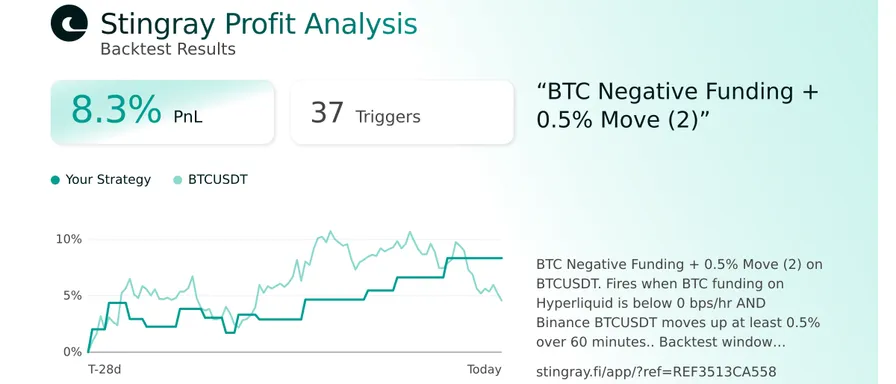
Stingray is built for strategy validation before live risk. You describe the thesis in plain English, Stingray turns it into a typed rule, runs the backtest, shows the trigger history, and monitors the same condition as an alert.
It is not meant to hide the strategy behind a magic bot. The product is the auditable artifact: rule, replay, evidence, alert, and activation controls.
For concrete examples, read Strategy Examples and How to Read a Backtest Card. For a derivatives-focused workflow, read Crypto Perpetual Trading: Backtest the Strategy Before You Go Live.
Verdict
Choose a trading strategy backtesting platform by the evidence it gives you, not by the confidence of its output.
The right platform should make a strategy easier to reject, refine, monitor, and control. If it cannot show the exact rule, the data, the trigger history, and the activation boundary, it is not ready to sit between a market idea and real capital.
Next reads:
 Web
Web