A practical guide to turning a perpetual trading idea into a precise rule, backtest, alert, and live monitoring workflow.
Short answer
Crypto perpetual trading should start with a testable rule, not with leverage.
Define the perpetual market, the price or funding signal, the risk boundary, and the review window. Backtest that exact rule against historical data, inspect every trigger, then monitor the same condition with live alerts. Use the evidence to decide whether the idea deserves more resources. Stingray does not place trades.
What is crypto perpetual trading?
Crypto perpetuals are futures-like contracts that do not have a fixed expiry date. Traders usually use them to express long or short exposure with leverage, while funding payments help keep the perpetual price close to the underlying market.
That structure creates useful strategy inputs:
- Funding rates show whether longs or shorts are paying to maintain exposure.
- Open interest shows whether positioning is expanding or contracting.
- Price behavior shows whether the market is confirming or rejecting the thesis.
- Liquidation zones and volatility show where risk can change quickly.
The danger is that those same inputs can make a strategy look obvious in real time and fragile in history. Backtesting is the checkpoint between a plausible idea and a rule worth monitoring.
The backtesting workflow
| Step | What to define | Why it matters |
|---|---|---|
| 1. Market | Asset, venue, and contract | BTC-PERP on Hyperliquid is not the same as ETH-PERP on another venue |
| 2. Direction | Long, short, neutral, or alert-only | The rule needs an explicit intent |
| 3. Signal | Funding, price, open interest, volatility, or a combination | Perpetual strategies usually fail when the signal is vague |
| 4. Threshold | The exact number or percentile | “High funding” needs a measurable boundary |
| 5. Cooldown | Minimum time between triggers | Prevents one crowded setup from firing repeatedly |
| 6. Review window | 1h, 4h, 24h, or custom horizons | Shows what happened after each trigger |
| 7. Activation path | Alert, preview, confirm, or execute where supported | Keeps research separate from live risk |
Example prompt
A useful perpetual trading prompt is specific:
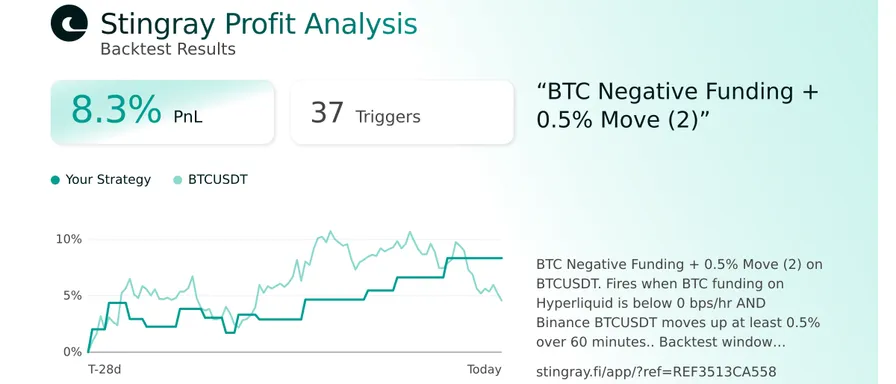
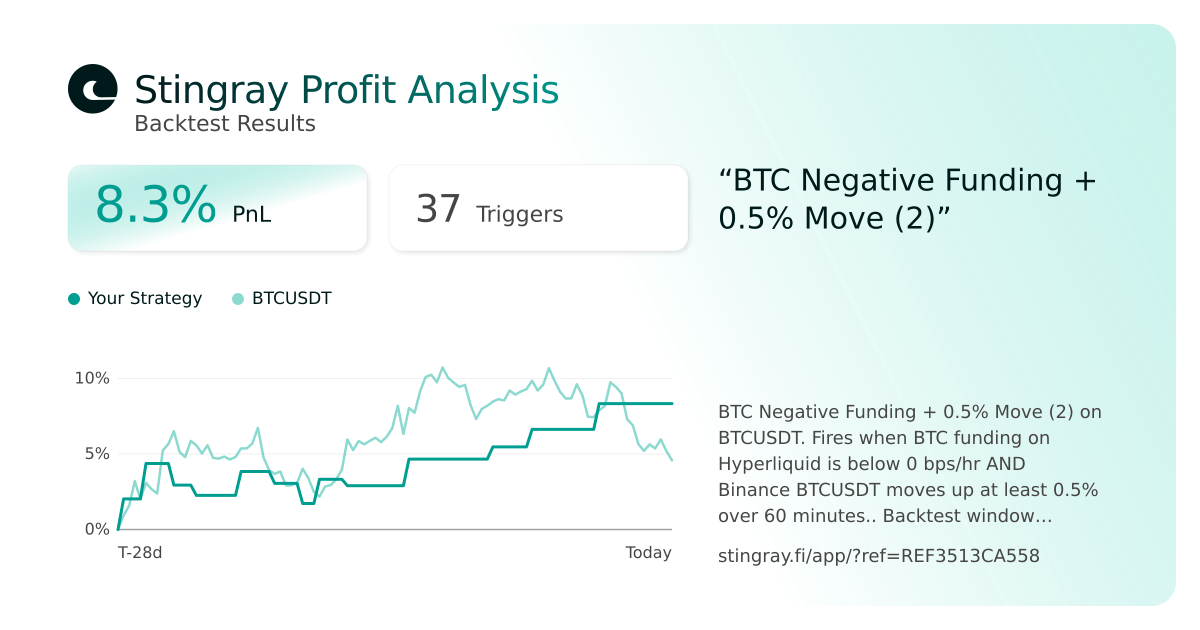
Backtest BTC-PERP on Hyperliquid. Signal when funding is negative, BTC rises at least 0.5% over 60 minutes, and open interest is rising. Use a 1-hour cooldown. Show every trigger and the 1-hour, 4-hour, and 24-hour forward returns before activation.
That prompt gives the system:
- The market and venue.
- The funding condition.
- The price confirmation.
- The positioning filter.
- The cooldown.
- The review horizons.
- A clear “do not activate yet” boundary.
The output should be a rule and a trigger history you can inspect, not a black-box trade suggestion.
Signals that matter in perpetual markets
Perpetual markets give you more than price. The most useful inputs are usually combinations:
- Funding plus price confirmation: negative funding and price strength can point to trapped shorts.
- Funding plus failed price action: extreme positive funding with failed breakouts can flag crowded longs.
- Open interest plus volatility: rising open interest into a sharp move can separate participation from drift.
- Cooldown plus regime filters: repeated triggers in the same hour often overstate a rule’s true opportunity set.
Do not ask the system to “trade perps well.” Ask it to test one precise behavior.
What to inspect before going live
Before live alerts or execution, review:
- How many times the rule fired after cooldown.
- Whether returns are concentrated in one market event.
- Whether fees, slippage, and funding payments would erase the result.
- Whether the opposite rule performed better.
- Whether a simpler version works just as well.
- Worst historical move after a trigger.
- How often the rule would have fired during volatile sessions.
- Whether the live data source is available for every condition.
A good perpetual strategy is not just profitable in a backtest. It is understandable when it fails.
Start with alerts, not orders
The first live version should notify you when the tested condition fires.
That alert stage answers questions a backtest cannot:
- Did the rule fire at times that match the thesis?
- Did it miss setups you expected?
- Did the live venue data line up with the historical test?
- Did the signal still look actionable after you saw the market context?
Compare the alerts with the frozen backtest, then continue, refine, or stop monitoring the rule.
Where Stingray fits
Stingray is built for the path from perpetual trading thesis to tested workflow. You describe the idea in plain English, Stingray turns it into a typed rule, backtests it, shows the trigger history, and then monitors the same condition as an alert.
For a concrete funding-rate example, read Backtest a Funding-Rate Rule in One Prompt. For a broader no-code workflow, read How to Automate an Onchain Trading Strategy Without Code.
Perpetual backtesting platforms compared
| Workflow | Historical evidence | Hyperliquid status | Best fit |
|---|---|---|---|
| Stingray | Typed multi-source rule, every fire, cooldown sets, forward outcomes, and coverage notes | Venue-aware funding and perpetual strategy workflows | Proving a custom thesis before monitoring |
| Coinrule | Historical backtests, paper trading, and parsed strategy rules | Official guide documents Hyperliquid perps, not spot | Testing and deploying a rule through one connected agent workflow |
| 3Commas | DCA-bot backtests with documented exchange and plan limits | Hyperliquid is not in the current DCA-backtest exchange list | Testing a known DCA configuration on supported exchanges |
| Cryptohopper | Visual strategies and full-bot backtesting workflows | Check current support for the exact product | Indicator-driven bot configuration and testing |
| Custom code | Fully configurable if the data and simulator are built correctly | Depends on the integration | Teams that need complete control and can maintain the stack |
Current sources: Coinrule documentation, Coinrule Hyperliquid setup, 3Commas DCA backtesting, Cryptohopper Strategy Designer, and Hyperliquid perpetuals API.
Use the full Trading Platform Comparison for the wider buyer guide.
Verdict
Crypto perpetual trading rewards precision and punishes vague automation.
Before going live, define the contract, funding or price signal, cooldown, risk boundary, and review window. Backtest the exact rule, inspect the triggers, and monitor the same condition with alerts.
Next reads:
 Web
Web