Learn how to turn open-interest divergence and whale-positioning context into an inspectable crypto alert before risking capital.
Short answer
Open-interest divergence happens when price and open interest stop confirming each other.
If price makes a higher high while open interest falls, the move may be driven by short covering rather than fresh leverage. If price drops while open interest rises, new shorts may be pressing the move. A whale feed adds context: are large accounts joining the move, reducing exposure, or sitting near liquidation?
That does not make a trade by itself. Treat open interest and whale activity as a rule you can backtest and monitor first, then use alerts before any execution.
What open-interest divergence means
Open interest is the total amount of outstanding perpetual or futures exposure. It rises when new leveraged positions are opened and falls when positions close.
Divergence appears when price and OI disagree:
| Price | Open interest | Common read |
|---|---|---|
| Up | Up | New leverage is supporting the move |
| Up | Down | Short covering may be driving the rally |
| Down | Up | New shorts or leveraged pressure may be entering |
| Down | Down | Deleveraging or capitulation may be underway |
Those reads are starting points, not instructions. The same pattern can behave differently across assets, venues, funding regimes, and event windows.
Why whale feeds matter
Aggregate OI tells you that leverage changed. It does not tell you whether the move came from broad positioning or one large account.
A whale feed can add useful context:
- Large new long or short positions.
- Rapid position reductions.
- Near-liquidation events.
- Concentration on one side of a market.
- Whether large accounts confirm or reject a price move.
For example, a price breakout with rising OI looks stronger if several large accounts are adding in the same direction. It looks more fragile if OI rises because one whale opened a position near liquidation while funding is already stretched.
A rule you can test
Do not write the strategy as “trade OI divergence.” Write it as a rule:
Track SOL-PERP on Hyperliquid. Alert me when price makes a higher high but aggregate open interest falls over the same window, funding stays positive, and no whale adds a confirming long position. Use a 4-hour cooldown and show 1-hour, 4-hour, and 24-hour forward returns.
That prompt defines:
- Market: SOL-PERP on Hyperliquid.
- Price condition: higher high.
- OI condition: aggregate OI falls over the same window.
- Funding filter: funding remains positive.
- Whale filter: no large account confirms with a new long.
- Cooldown: one signal per 4 hours.
- Review windows: 1h, 4h, and 24h after each trigger.
Now the idea can be reviewed. You can inspect when it fired, what the market looked like, and whether the behavior repeated outside one lucky week.
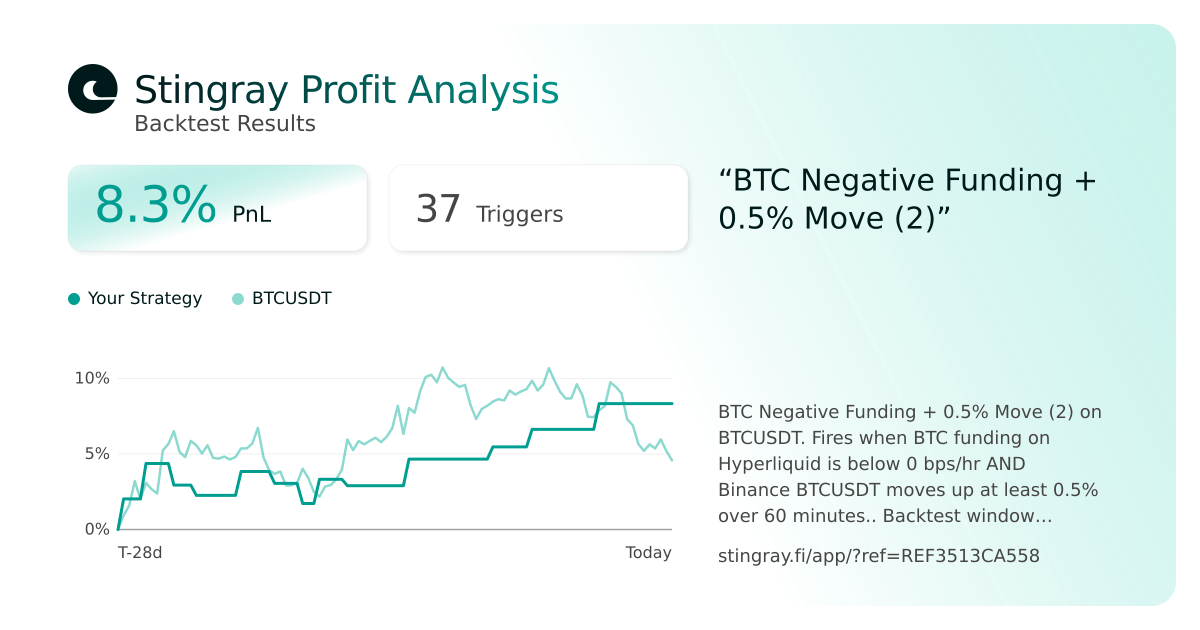
Backtest the signal before using it live
An OI divergence rule should answer basic questions before it becomes a live alert:
- How often did the rule fire after cooldown?
- Did the result depend on one asset or one market regime?
- Did the edge remain after fees, slippage, and funding?
- Were the best fires tied to macro events, liquidations, or news?
- Did whale confirmation improve the signal or make it too rare?
- What happened when the same rule was tested on a different pair?
The goal is not to find a flattering chart. The goal is to find out whether the signal is stable enough to watch in real time.
Start with alerts
The safest path is:
- Build the divergence rule.
- Backtest the exact trigger history.
- Review examples where the rule worked and failed.
- Run it as an alert.
- Compare live behavior with the backtest, then continue, refine, or stop monitoring.
This matters because OI divergence can persist. A short-covering rally can keep running. A crowded short can become more crowded before it unwinds. Whale activity can be defensive, hedged, or misleading if you do not know the full position.
Where Stingray fits
Stingray is built for this middle layer between a thesis and live risk: describe the rule in plain English, translate it into an inspectable trigger, backtest it against Hyperliquid history where supported, and monitor the same condition as an alert.
For related workflows, read How to Automate a Funding Rate Strategy on Hyperliquid, How to Backtest a Strategy with Funding Rates and Macro Events, and How to Automate an Onchain Trading Strategy Without Code.
Checklist before acting
Before you treat an OI divergence as actionable, check:
- Price window and OI window match.
- Funding is included or intentionally ignored.
- Whale confirmation is defined by position change, not vague “smart money” language.
- Cooldown prevents duplicate fires.
- Forward returns are reviewed at multiple horizons.
- The first live stage is an alert, not a blind order.
Verdict
Open-interest divergence is useful because it asks whether price movement is supported by fresh leverage. Whale feeds are useful because they show whether large accounts are confirming that move.
Use both as evidence, not as a shortcut. Define the rule, backtest it, inspect the trigger history, and start with alerts before moving closer to execution.
 Web
Web