Learn how to turn a Chia price chart read into a precise no-code alert rule with confirmation, invalidation, backtesting, and review windows.
Short answer
Do not automate a Chia price chart read by saying “the chart looks bullish.”
Turn the read into a rule: timeframe, pattern, confirmation, invalidation, cooldown, and review window. Then backtest the exact condition before using it as a live alert.
This works for Chia (XCH) the same way it works for any crypto asset: the chart idea has to become precise before automation helps.
What a chart pattern needs before automation
A chart pattern is only useful if someone else could apply the same rule and get the same signals.
Define:
- Timeframe: 1h, 4h, daily, or weekly.
- Pattern: breakout, range reclaim, failed breakdown, moving-average reclaim, or volatility squeeze.
- Trigger: the exact candle close or threshold.
- Confirmation: volume, BTC regime, volatility, or a second candle.
- Invalidation: the level or condition that proves the read wrong.
- Cooldown: how often the alert may fire.
- Review window: what to measure after the alert fires.
If any of those are missing, the automation will only make a vague chart opinion fire faster.
Example Chia chart rule
Here is a simple rule shape:
| Component | Example |
|---|---|
| Asset | XCH |
| Timeframe | Daily |
| Pattern | Moving-average reclaim |
| Trigger | Daily close above the 20-day moving average after at least 5 closes below it |
| Confirmation | Volume above the 7-day average |
| Market filter | BTC is not down more than 3% on the day |
| Invalidation | Close back below the reclaim candle low |
| Cooldown | 24 hours |
| Review | 1d, 3d, and 7d forward returns |
Those numbers are examples, not recommendations. The point is that the chart read is now testable.
Example prompt
Use plain English, but make it exact:
Backtest XCH on the selected liquid venue. Alert when the daily candle closes above the 20-day moving average after at least 5 daily closes below it, volume is above the 7-day average, and BTC is not down more than 3% on the day. Invalidate if XCH closes below the reclaim candle low. Use a 24-hour cooldown and show 1-day, 3-day, and 7-day forward returns.
That prompt defines:
- Asset: XCH.
- Pattern: reclaim after weakness.
- Trigger: daily close above the 20-day moving average.
- Confirmation: volume above recent average.
- Market filter: BTC is not in a sharp same-day drawdown.
- Invalidation: close below the reclaim candle low.
- Review windows: what happened after each fire.
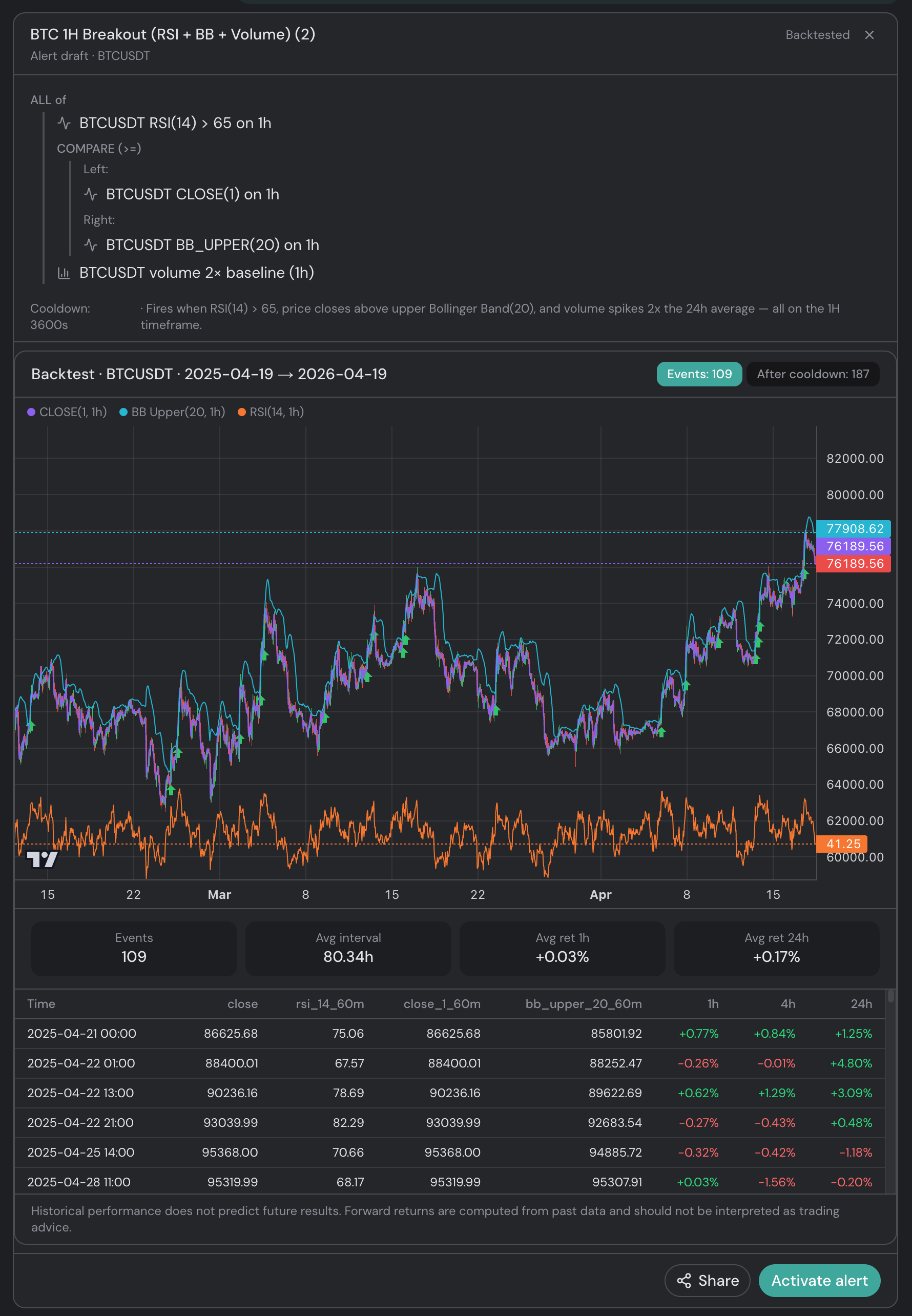
Backtest before live alerts
Before a Chia chart rule goes live, inspect:
- Number of historical fires.
- Whether results are dominated by one market cycle.
- Whether volume confirmation improved the rule.
- Whether the invalidation level caught failed breakouts.
- Whether BTC regime explained the forward returns.
- Whether the rule still worked with a simpler threshold.
- Whether spread and venue liquidity made the signal realistic.
If the rule only works after repeatedly changing the threshold to match the chart, it is not ready.
Start with alerts, not orders
The first automation win is not execution. It is consistency.
An alert version lets you see whether the same Chia chart read behaves live the way it did in the backtest. When it fires, review:
- Did the candle close exactly as expected?
- Was the volume confirmation real?
- Did broader crypto market conditions agree?
- Did the invalidation trigger quickly?
- Would the setup still make sense if you had no position?
Only after that should any execution workflow be considered.
Where Stingray fits
Stingray turns chart language into an inspectable strategy rule, backtests it, and monitors the same condition as an alert. That is useful when the user wants no-code automation but still needs the discipline of a typed rule.
For related workflows, read BTC Breakout Alert Backtested, How to Automate an Onchain Trading Strategy Without Code, and WAL Price Strategy: From Thesis to Backtest in Plain English.
Verdict
Chia price chart automation should start with a repeatable rule, not a visual opinion.
Define the pattern, trigger, confirmation, invalidation, cooldown, and review window. Backtest it, inspect failed fires, and run the first live version as an alert.
 Web
Web