Compare Stingray and WunderTrading for onchain automation, from Hyperliquid strategy backtesting to TradingView-driven bot execution.
Short answer
Use WunderTrading when the signal is already defined and the job is automation: TradingView alerts, bot execution, copy trading, DCA, grid, or exchange-connected workflows.
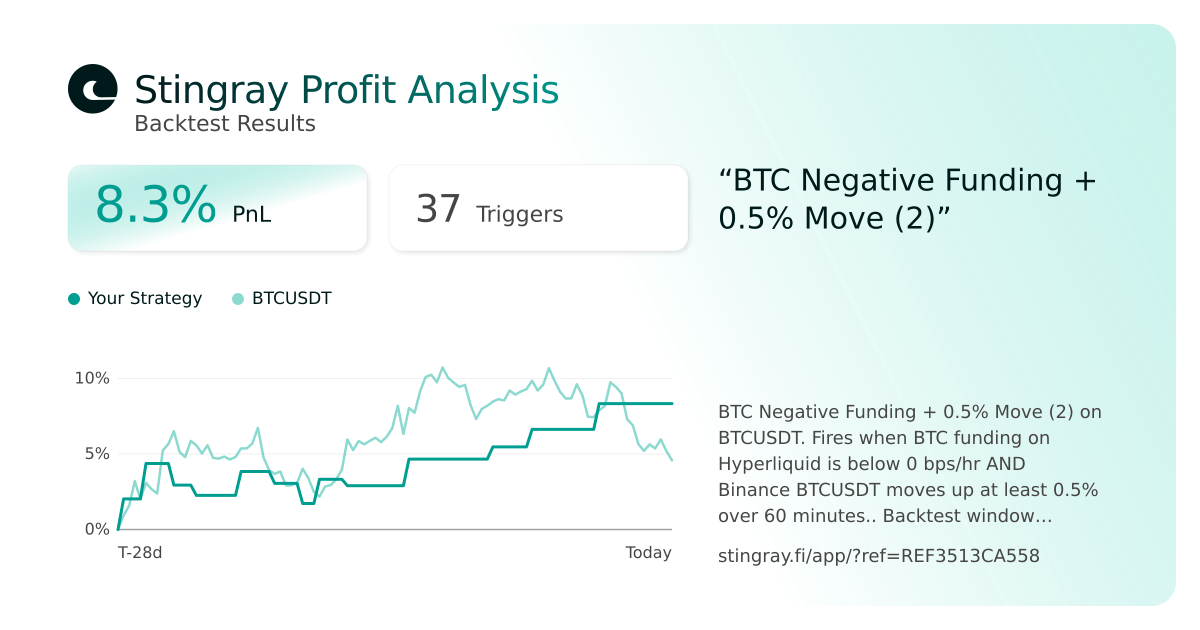
Use Stingray when the hard part is deciding whether a Hyperliquid strategy should run at all. Stingray starts with the thesis, turns it into a typed rule, backtests the historical fires, and monitors the same condition before execution is considered.
The difference is not “AI versus bot.” The difference is proof before automation.
Feature comparison
| Job | Stingray | WunderTrading |
|---|---|---|
| Plain-English strategy creation | Strong | Limited |
| Hyperliquid funding and perp research | Strong | Check current exchange support and bot coverage |
| Typed-rule backtesting before activation | Strong | Not the core job |
| Natural-language alerts | Strong | Limited |
| TradingView alert routing | Not the core job | Strong |
| DCA, grid, signal, and copy-trading bots | Not the core job | Strong |
| Execution console for prepared strategies | Limited | Strong |
| Evidence review before live risk | Strong | Usually handled outside the execution layer |
Where Stingray wins
Choose Stingray when you are still deciding what the strategy is.
That includes:
- Hyperliquid funding-rate ideas.
- Open-interest divergence.
- Price plus venue-behavior setups.
- Whale-flow or wallet-monitoring signals.
- Macro or news filters.
- Polymarket or event-probability inputs.
- Plain-English rules that need to be tested before they are trusted.
For example:
Backtest ETH longs on Hyperliquid when funding is negative, open interest is rising, price has reclaimed the 20-day moving average, and BTC is not in a sharp same-day drawdown. Show 1-day, 3-day, and 7-day forward returns.
That is not just an execution instruction. It is a market thesis. Stingray is the better layer for making it precise and checking whether it worked historically.
Where WunderTrading wins
Choose WunderTrading when the signal is already known and the main job is running it.
It can be a better fit when:
- Your strategy already lives in TradingView.
- You want to route alerts into bot execution.
- You need DCA, grid, signal, copy-trading, or prepared bot workflows.
- You already know the trigger, action, sizing, and exchange.
- You are comfortable doing research and backtest review outside the execution console.
In that workflow, WunderTrading is the operations layer. It is useful after the strategy has been defined.
The Hyperliquid question
Hyperliquid strategies often depend on more than price.
A serious Hyperliquid rule may combine:
- Funding rate.
- Open interest.
- Perp venue behavior.
- BTC or ETH regime.
- Liquidation or whale-flow context.
- News or macro filters.
- Cooldown, invalidation, and review windows.
That is why the backtest matters. Before a bot routes a signal, the trader should know whether the same condition had repeatable historical behavior.
Stingray is built around that earlier step: make the rule inspectable, run the backtest, review the fires, and only then decide whether monitoring or execution makes sense.
Practical workflow
A realistic combined workflow looks like this:
- Research in Stingray: describe the Hyperliquid setup in plain English.
- Backtest in Stingray: inspect historical fires, forward returns, failed signals, and regime splits.
- Monitor in Stingray: turn on alerts for the same typed rule.
- Execute elsewhere when ready: use an execution tool only after the rule, sizing, and invalidation are clear.
- Review the loop: compare live fires with the original evidence.
This avoids the common no-code trap: automating a signal because it is easy to route, not because it has been proven.
Verdict
WunderTrading is a strong fit for execution-first onchain automation, especially when the strategy is already defined or begins in TradingView.
Stingray is the better fit when the question is: “Should this Hyperliquid strategy exist, and what happened when it fired historically?”
Use Stingray before the bot when strategy proof matters.
Next reads:
 Web
Web