Learn how to turn World Mobile Token price volatility into a testable crypto alert rule with venue checks, volatility filters, and review windows.
Short answer
World Mobile Token price volatility should be modeled as a condition, not a headline.
Before building a rule, confirm the ticker and venue you are using. Some sources may show WMTX while older references may show WMT. Then define what volatility means: range expansion, average true range, realized volatility, volume spike, or a breakout after compression.
Once the volatility definition is clear, backtest it and start with alerts.
Define the market first
Ticker and venue matter for smaller crypto assets.
Before testing a World Mobile Token rule, define:
- The ticker and data source you trust.
- The exchange or index used for price history.
- Whether volume is reliable or concentrated.
- Whether spreads are acceptable for the position size.
- Whether the rule should use spot, perp, or index pricing.
Without that, a volatility backtest can be testing a bad feed instead of a market behavior.
Choose the volatility idea
Volatility can mean several different things:
| Idea | Example trigger |
|---|---|
| Breakout volatility | Daily range is 2x the 20-day average and price closes above resistance |
| Compression release | 7-day realized volatility is near a 30-day low, then price breaks the range |
| Mean reversion after spike | Price moves more than 15% in a day and then fails to continue |
| Volume-confirmed move | Price breaks a level while volume is above the 7-day average |
| Risk-off filter | Do not fire if BTC is in a sharp same-day drawdown |
Do not mix all of them at once. Pick one volatility thesis and test it cleanly.
Example prompt
Use plain English, but make it precise:
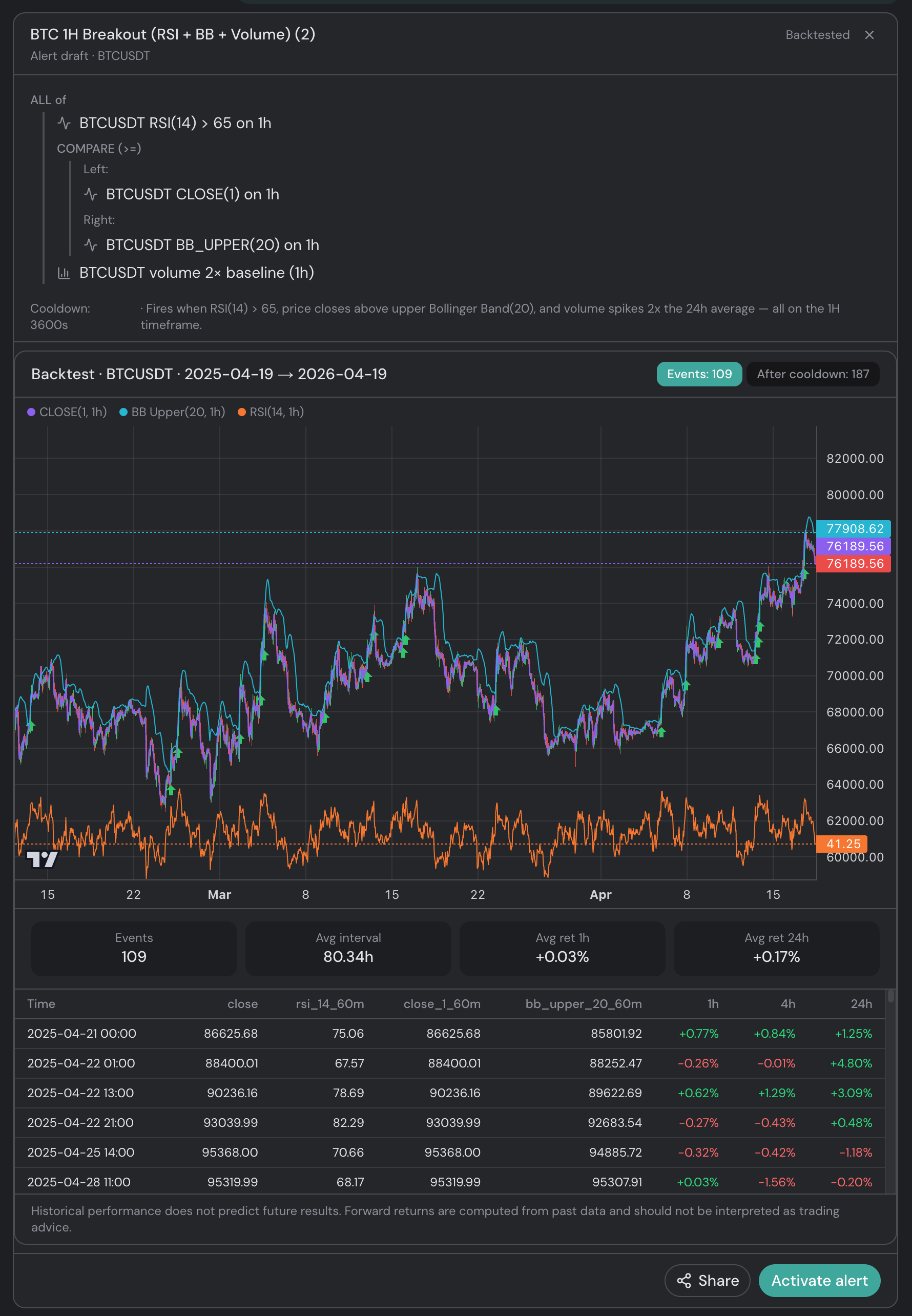
Backtest World Mobile Token on the selected liquid venue. Alert when the daily range is at least 2x the 20-day average range, price closes above the prior 10-day high, volume is above the 7-day average, and BTC is not down more than 3% on the day. Use a 24-hour cooldown. Show 1-day, 3-day, and 7-day forward returns, and show failed breakouts separately.
That prompt defines:
- Asset and venue: the selected World Mobile Token market.
- Volatility condition: daily range at least 2x the 20-day average.
- Price confirmation: close above prior 10-day high.
- Volume confirmation: volume above recent average.
- Market filter: BTC is not in a sharp selloff.
- Review windows: 1d, 3d, and 7d after each signal.
What to inspect in the backtest
A volatility strategy can look good because one event dominates the sample. Check:
- Number of fires.
- Whether returns came from one listing, announcement, or exchange move.
- Whether the rule worked in calm and volatile market regimes.
- Whether volume confirmation improved the result.
- Whether spread and slippage would erase the edge.
- Whether BTC regime controlled the signal.
- Whether failed breakouts were frequent.
The backtest should show both continuations and failures.
Add fundamental context without overfitting
If your World Mobile Token thesis depends on network adoption, ecosystem announcements, or exchange liquidity, keep those as separate context fields.
For example:
- Alert only when price volatility expands after a verified catalyst.
- Compare catalyst days with quiet days.
- Track whether volume confirmation matters more around news.
- Avoid using later event outcomes as if they were known at the trigger.
This keeps the strategy honest: the rule should only use information available at the time.
Start live with alerts
Run the first version as an alert. When it fires, check:
- Did the volatility condition match the backtest?
- Was volume real or thin?
- Did the price close confirm, or was it an intraday wick?
- Was the broader crypto market driving the move?
- Did invalidation trigger quickly?
Only after live behavior is understood should execution be considered.
Where Stingray fits
Stingray turns a volatility thesis into a typed rule, backtests historical fires, and monitors the same condition as an alert. That is useful for token-specific ideas because it keeps the strategy grounded in testable conditions instead of chart excitement.
For related workflows, read Chia Price Chart Patterns: Automating Your Read Without Code, WAL Price Strategy: From Thesis to Backtest in Plain English, and How to Automate an Onchain Trading Strategy Without Code.
Verdict
World Mobile Token volatility is only useful as a strategy input when it is defined precisely.
Confirm the venue, define the volatility condition, add confirmation and invalidation, backtest the history, and start with alerts.
 Web
Web