Learn how to evaluate the 币安人生 / Binance Life meme coin search trend with contract checks, liquidity filters, catalyst tags, and alert-first backtesting.
Short answer
币安人生, often translated as “Binance Life,” is a meme-coin search term. Treat it as a high-risk token narrative, not as proof of official Binance affiliation.
Before building any strategy around it, confirm the exact contract, chain, venue, liquidity, and ticker used by your data source. Meme coin names can collide, duplicate, or change quickly.
Once the market is verified, turn the idea into a backtestable rule and start with alerts.
First: verify the market
Do not backtest a meme coin until the market identity is clear.
Check:
- Exact token contract.
- Chain and venue.
- Whether the market is spot, DEX pool, or indexed price.
- Daily liquidity and spread.
- Holder concentration.
- Whether volume is real or wash-like.
- Whether the name implies an unofficial association.
If two sources disagree on the contract or ticker, stop and resolve that first.
Define the thesis
A meme coin strategy needs a measurable thesis.
| Thesis | Example condition |
|---|---|
| Momentum after social attention | Price closes above the prior 24h high while volume is above the 7-day average |
| Mean reversion after spike | Price moves more than 30% in 24h and then fails to hold half the move |
| Liquidity expansion | DEX liquidity rises by a defined amount before price breaks range |
| Failed breakout | Price wicks above a prior high but closes back inside the range |
| Risk filter | Do not fire when BTC or BNB is in a sharp same-day drawdown |
The numbers are examples. The important part is that the rule can be tested.
Example prompt
Use a precise prompt:
Backtest the verified 币安人生 / Binance Life market on the selected liquid venue. Alert when price closes above the prior 24-hour high, volume is above the 7-day average, liquidity has not fallen over the past 24 hours, and BTC is not down more than 3% on the day. Use a 12-hour cooldown. Show 4-hour, 24-hour, and 3-day forward returns, and separate failed breakouts.
That defines:
- Asset identity: the verified token market.
- Price trigger: close above the prior 24-hour high.
- Volume confirmation: volume above recent average.
- Liquidity filter: liquidity is not deteriorating.
- Market filter: BTC is not in a broad selloff.
- Review windows: 4h, 24h, and 3d after each alert.
What to inspect
Meme coin backtests can look good for the wrong reason. Inspect:
- Whether one launch or influencer event dominates the result.
- Whether liquidity was sufficient at the signal time.
- Whether failed breakouts were frequent.
- Whether spreads would erase the edge.
- Whether the signal worked outside the first hype window.
- Whether broader BTC or BNB conditions explained the move.
- Whether contract risk or venue risk changed the tradeability.
If the rule only works during one viral burst, treat it as an alert rule, not a durable strategy.
Where Stingray fits
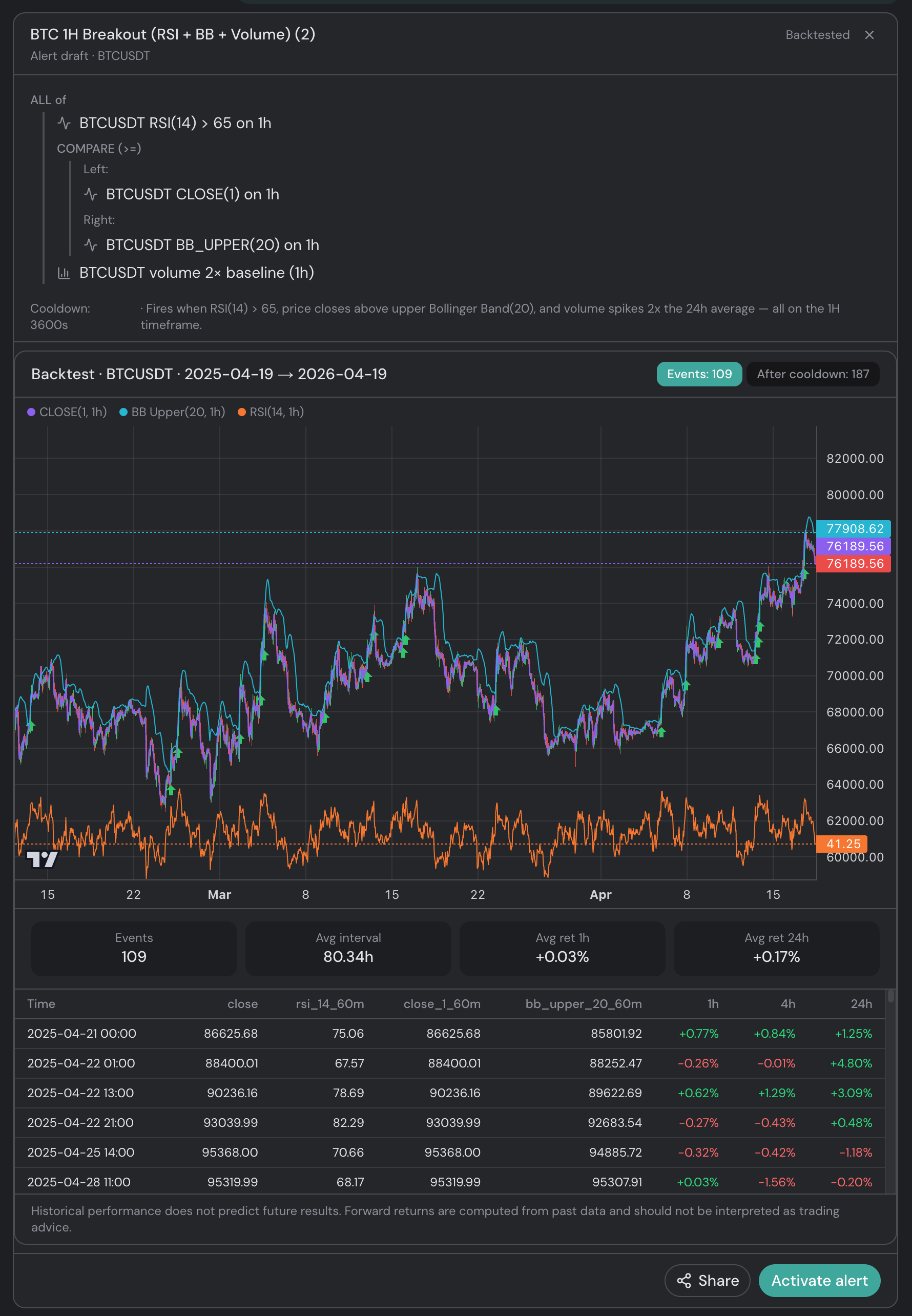
Stingray turns a meme coin thesis into a typed rule, backtests historical fires, and monitors the same condition as an alert. That is useful for fast-moving tokens because it forces the idea to pass through identity checks, liquidity filters, and review windows before any live decision.
For related workflows, read How to Automate an Onchain Trading Strategy Without Code, World Mobile Token Price Volatility: Building a Backtest Around It, and Midnight Crypto Price Swings: How to Automate a Strategy Around Them.
Verdict
币安人生 / Binance Life should be handled as a speculative meme coin topic.
Verify the contract, confirm liquidity, define the exact price rule, backtest it, inspect failed fires, and start with alerts before considering any execution.
 Web
Web