Learn how to turn Midnight crypto price swings into a testable alert rule with asset checks, volatility filters, catalysts, and backtest review windows.
Short answer
Do not automate a Midnight crypto price swing by reacting to every candle.
First confirm the asset. In most token-specific searches, “Midnight” means the Midnight Network’s NIGHT token, not the time of day. Then define the venue, liquidity source, volatility condition, catalyst context, and invalidation rule before you backtest.
Once those pieces are explicit, the idea becomes a strategy rule instead of a headline.
Confirm the asset and venue
“Midnight crypto price” can be ambiguous.
Before building a rule, define:
- Asset: NIGHT, or the exact market your data source uses.
- Venue: the exchange, DEX, or index used for price history.
- Liquidity: whether volume is reliable enough for your position size.
- Quote currency: USDT, USD, ADA, BTC, or another quote.
- Data timing: whether the strategy uses hourly, daily, or intraday candles.
- Catalyst context: launch, unlock, redemption, listing, or ecosystem news.
This prevents the backtest from mixing different markets or reacting to a thin feed.
Choose the price-swing thesis
A price swing is not a strategy until it is measurable.
| Thesis | Example trigger |
|---|---|
| Momentum after volatility expansion | Daily range is at least 2x the 20-day average and price closes above the prior 7-day high |
| Failed breakout | Price breaks the prior 10-day high intraday but closes back inside the range |
| Mean reversion after a spike | Price moves more than 15% in 24 hours and then fails to hold half the move |
| Catalyst-confirmed move | Price volatility expands after a verified listing, unlock, or ecosystem event |
| Risk filter | Do not fire if BTC or ADA is in a sharp same-day drawdown |
Pick one thesis. Combining all of them usually creates a rule that cannot be trusted.
Example prompt
Use plain English, but make every condition testable:
Backtest NIGHT on the selected liquid venue. Alert when the daily range is at least 2x the 20-day average range, price closes above the prior 7-day high, volume is above the 7-day average, and BTC is not down more than 3% on the day. Tag whether a verified catalyst occurred in the prior 72 hours. Use a 24-hour cooldown and show 1-day, 3-day, and 7-day forward returns.
That prompt defines:
- Asset and venue: NIGHT on the selected market.
- Volatility condition: daily range versus the 20-day average.
- Price confirmation: close above the prior 7-day high.
- Volume confirmation: volume above recent average.
- Market filter: BTC is not in a sharp selloff.
- Catalyst tag: recent news is tracked without forcing the rule to depend on it.
- Review windows: 1d, 3d, and 7d after each alert.
What to inspect in the backtest
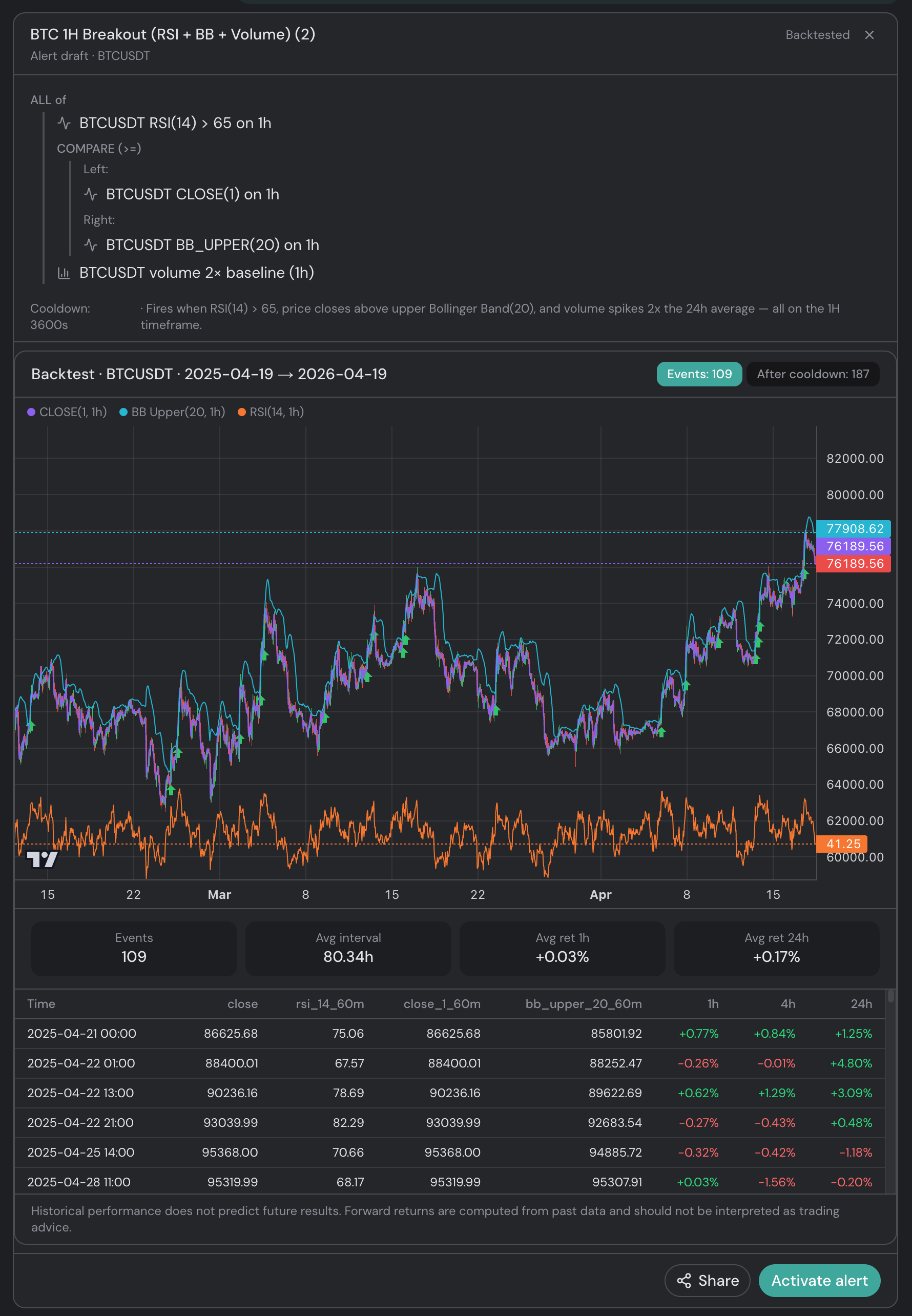
Small and recently listed markets can produce misleading results. Inspect:
- Number of historical fires.
- Whether one listing or redemption event dominates returns.
- Whether the signal worked outside launch-week volatility.
- Whether volume confirmation removed thin-market moves.
- Whether failed breakouts were common.
- Whether BTC and ADA regime explain most of the move.
- Whether slippage would erase the expected edge.
The goal is not to prove that a token is exciting. The goal is to learn whether the exact condition had repeatable behavior.
Add catalyst context carefully
Midnight-related price moves may be tied to network updates, token distribution, exchange listings, or ecosystem news.
Use those as context fields:
- Tag fires that happened near a verified catalyst.
- Compare catalyst days with quiet days.
- Keep unlock or redemption windows separate from the price trigger.
- Avoid using information that was not known when the signal fired.
This lets you see whether the price rule works on its own or only during one-off events.
Start with alerts
The first live version should be an alert, not automatic execution.
When it fires, check:
- Did the candle close confirm the swing?
- Was the venue liquid enough?
- Did broader crypto conditions drive the move?
- Was there a catalyst, or was it only a chart event?
- Did invalidation trigger quickly?
Those checks make the second version better.
Where Stingray fits
Stingray turns a Midnight price-swing thesis into a typed rule, backtests historical fires, and monitors the same logic as an alert. That is useful when the trade idea starts as a token narrative but needs to become a repeatable workflow.
For related workflows, read World Mobile Token Price Volatility: Building a Backtest Around It, Chia Price Chart Patterns: Automating Your Read Without Code, and How to Automate an Onchain Trading Strategy Without Code.
Verdict
Midnight crypto price swings are only useful for automation when the asset, venue, volatility trigger, catalyst context, invalidation, and review windows are explicit.
Backtest the rule, inspect failed fires, and run the first version as an alert before considering execution.
 Web
Web